
Opioid dependence · Mexico City
Ibogaine Treatment for Opioid Addiction
The dependence ibogaine has the most published evidence for. This page also says what that evidence does not show.
1 supervised dose, inside a 7-day medical program, for heroin, fentanyl, oxycodone and hydrocodone, and for methadone or Suboxone once a transition is finished. Every case is read by a cardiologist before a deposit is taken. The screening that approves people is the same screening that turns them away.
The short answer
What is ibogaine treatment for opioid addiction?
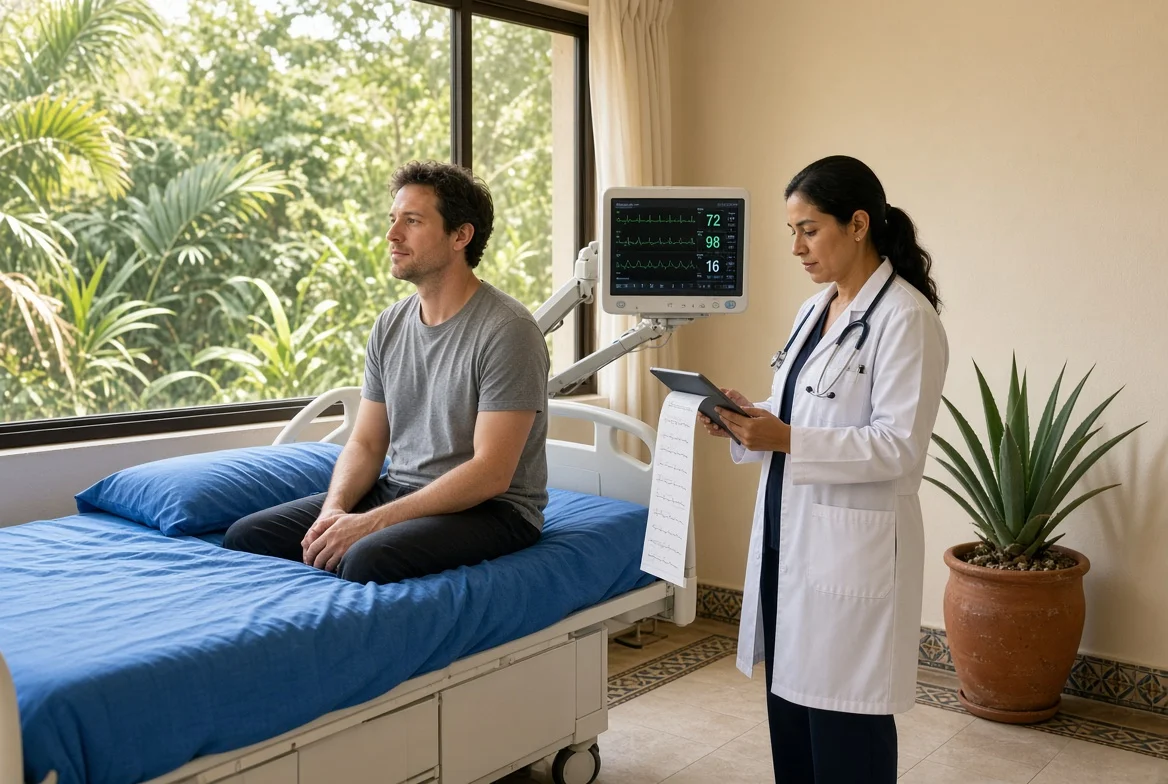
Ibogaine treatment for opioid addiction is a single physician-supervised dose of ibogaine hydrochloride, given in a licensed medical facility under continuous cardiac monitoring, to interrupt opioid withdrawal and reduce craving. At Ibogaine Treatment MX it runs as a 7-day inpatient program in Mexico City for $12,500, followed by 90 days of clinical follow-up. It is not a cure, it is not approved by the FDA, and it is not given to anyone whose EKG, electrolytes or medication list fall outside written cardiac thresholds.
| Opioids treated | Heroin, fentanyl, oxycodone, hydrocodone. Methadone and Suboxone after a planned transition. |
|---|---|
| How it is given | 1 supervised oral dose of pharmaceutical-grade ibogaine HCl, on day 3 of a 7-day stay. |
| Where | A licensed medical facility in Mexico City, 9 minutes from a JCI-accredited hospital under a written transfer agreement. |
| Program length | 7 nights inpatient, then 90 days of structured follow-up. |
| Cost | $12,500, itemised, with 5 stated exclusions. No financing and no lender referrals. |
| Who is in the room | A cardiologist, an emergency physician and an ACLS-trained nurse, 1 to 1, through the session and the night. |
| Monitoring | Continuous 12-lead ECG and pulse oximetry, overnight telemetry, crash cart on site. |
| Screening before travel | 12-lead EKG read by our cardiologist, potassium, magnesium, a liver panel, and a full medication review. |
| Legal status | Not a scheduled substance in Mexico. Schedule I in the United States. Not FDA approved anywhere. |
| Most common outcome of screening | “Not yet”, and usually because of a medication rather than a heart. |
How it works
Why 1 dose interrupts opioid withdrawal.
Ibogaine does not act on 1 receptor. It acts on several at once, and it leaves behind a metabolite that outlasts the session by days. That combination is the working explanation for what patients report. It is an explanation, not a proof.
1 · During the session
Several receptor systems at once
Ibogaine acts as a kappa-opioid agonist, a weak mu-opioid antagonist and an NMDA receptor antagonist, and interacts with the serotonin and dopamine transporters. The mu activity is the part most closely tied to withdrawal falling away rather than building.
2 · After the session
A metabolite that lasts days
The liver enzyme CYP2D6 converts ibogaine into noribogaine, which stays in the body long after ibogaine itself has cleared. That persistence is the leading explanation for why craving is reported as reduced for weeks, not hours. How quickly you make it varies between people.
3 · What is inferred
The part shown mostly in animals
Ibogaine induces neurotrophic factors, BDNF and GDNF, in the brain regions that handle reward. That is the proposed reason for a lasting change in drug-seeking, and almost all of it comes from animal studies. Nobody has isolated which of these mechanisms does the work in people.
What patients describe is withdrawal falling within hours instead of building over days. What the published data shows is withdrawal scores dropping within 36 hours in a monitored inpatient series. Neither is a promise about what happens after you fly home.
Eligibility by substance
Which opioids we treat, and which need a transition first.
Long-acting opioids cannot be dosed directly. That is not a scheduling preference, it is the reason some people are told “not yet” on the first call. The transition is planned with your own prescriber, and no deposit is taken until the plan is in writing.
| Opioid | Treated | What has to happen first |
|---|---|---|
| Heroin | Yes | The timing of your last use is confirmed on the screening call, because it sets how days 1 and 2 are planned. |
| Fentanyl | Yes | A longer washout than any other opioid on this page, set case by case by the physician. Fentanyl exposure is asked about directly, and it is never treated as a judgement. |
| Oxycodone, hydrocodone OxyContin, Percocet, Vicodin, Norco | Yes | The full prescription list is reviewed for anything that also prolongs the QT interval, and paused only with your prescriber’s agreement. |
| Methadone | After transition | Transition to a short-acting opioid, planned by our psychiatrist with your prescriber. Methadone prolongs the QT interval on its own, so it is never dosed alongside ibogaine. The timeline is measured in weeks. |
| Suboxone, buprenorphine | After transition | Buprenorphine’s long action means it has to clear before a dose is possible. Same process, same psychiatrist, same weeks-not-days timeline. Nobody is asked to stop on their own. |
| Codeine, tramadol, morphine | Case by case | Screened under the same opioid protocol. Tramadol gets an extra look because of its own seizure and serotonergic risk. |
The stay
What the 7 days look like for an opioid case.
The difference between an opioid stay and any other stay is day 2. Withdrawal is managed by a physician before dosing, not left to you in a room to get through on your own.
Day 1 · Arrival
The decision is re-made on new numbers
Private driver from MEX Terminal 1. Repeat 12-lead EKG and repeat labs, compared against the trace we approved you on. Full medication reconciliation. If the numbers have moved, the answer changes, and it changes here rather than in the dosing room.
Day 2 · Withdrawal
Managed, not endured
The physician manages withdrawal directly, with the nurse on site through the night. Potassium and magnesium are corrected, because withdrawal depletes both and low electrolytes make ibogaine’s cardiac effect worse. Dosing does not happen until those values are in range.
Day 3 · Dosing
1 dose, 3 clinicians, continuous monitoring
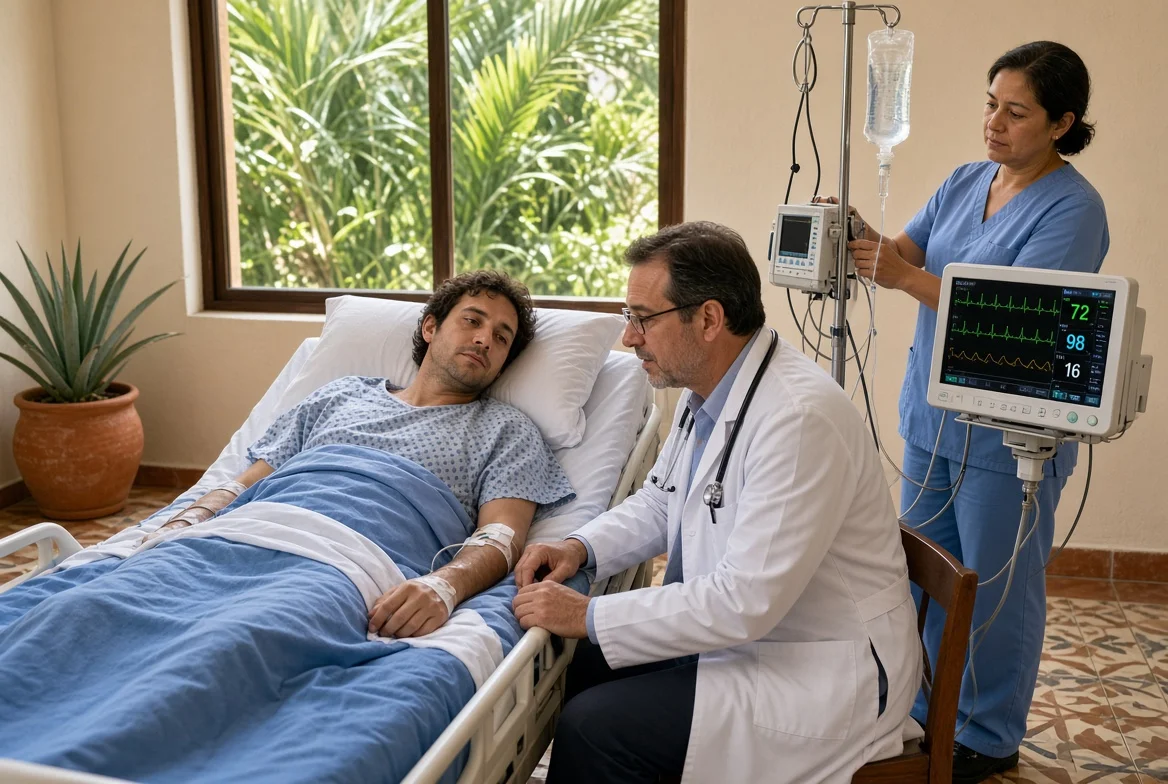
A cardiologist, an emergency physician and an ACLS-trained nurse in the room. Continuous 12-lead ECG and pulse oximetry through the session and overnight. The session runs several hours, followed by a longer reflective phase in which sleep is limited.
Day 4 · Telemetry
Monitored through the tail
Overnight telemetry and a morning EKG. Noribogaine is still active, so monitoring continues past the point most people assume the treatment has ended.
Days 5 to 6 · Recovery
Sleep, food, and the psychiatrist
Appetite and sleep return unevenly. Psychiatrist sessions start here, and discharge planning happens with your home clinician rather than after you land.
Day 7 · Discharge
You leave with it in writing
A written clinical summary for your own physician, the referral list of US clinicians, the follow-up call schedule, and the tolerance warning below said out loud before you go.
The risk we screen for
Why opioid dependence changes the cardiac screen.
Ibogaine blocks the hERG potassium channel in heart muscle, which delays repolarisation and prolongs the QT interval. A prolonged QT can lead to a fatal arrhythmia. That is the mechanism behind every death associated with ibogaine, and it is the reason the screening exists.
- Methadone stacks the same risk. Methadone prolongs the QT interval on its own. Adding ibogaine to it doubles down on a single mechanism, which is why a transition comes first and is never negotiable.
- Withdrawal empties the electrolytes. Vomiting, diarrhoea and poor intake drop potassium and magnesium, and low levels of both make the QT effect worse. They are corrected before travel and rechecked on day 1.
- High-dose loperamide is a real finding. People self-managing withdrawal often take large amounts of loperamide, which is itself cardiotoxic at those doses. We ask about it directly, because it will not appear on a prescription list.
- A clean heart is not a free pass. The published cardiology literature is clear that pre-existing heart disease is not required for a fatal event. That is why the threshold is a written number on a trace, not a judgement about how healthy someone looks.
The decision is a cardiologist reading your EKG against written thresholds, before a deposit exists. It is not a form, and it is not made by whoever answers the phone.
The evidence
What the published studies show for opioids, and what they do not.
3 studies carry most of the weight. All 3 are small, none has a control group, and outcomes are self-reported. No randomised controlled trial of ibogaine for opioid dependence has been published.
Brown and Alper · 2018
30 opioid-dependent people, treated in Mexico
12 of the 30 reported a 75% reduction in opioid use at 30 days. 1 in 3 reported complete abstinence at 3 months.
Does not show: what happens beyond 3 months, or what would have happened without ibogaine. 30 people, no control group. PubMed
Noller and colleagues · 2018
14 people in New Zealand, followed 12 months
Addiction Severity Index drug-use scores fell significantly from baseline to 12 months, and depression scores fell with them. This is the longest follow-up published.
Does not show: safety. 1 of the 14 participants died during treatment. Only 8 completed every interview. PubMed
Mash and colleagues · 2018
102 opioid-dependent inpatients, monitored setting
Withdrawal scores fell within 36 hours of dosing. Craving fell at discharge and at 1 month. No serious adverse events at the doses used.
Does not show: durability, or safety outside a monitored facility. Follow-up stopped at 1 month. Full paper
In 2025 the State of Texas funded $50 million of FDA-supervised ibogaine clinical trials, led by UTHealth Houston with UTMB Health. Those trials were being set up through 2026 and will take years to report. Until they do, every figure above comes from a small observational study, and we will not present it as more than that. The full evidence page includes the forensic review of ibogaine-associated deaths.
Who we decline
The opioid cases we turn away.
Some of these are a permanent no. Some are a “not yet” that becomes a yes once something is corrected. Either way the answer comes in writing, with the reason, and any deposit is refunded in full.
- Benzodiazepine dependence alongside the opioid. Benzodiazepine withdrawal can cause seizures and a safe taper takes months. It has to be tapered under your own doctor before we can screen you.
- A QTc above our written threshold, or conduction disease on the EKG. Correctable causes are a not yet. A structural finding is a no.
- Structural heart disease, heart failure, cardiomyopathy or a prior cardiac event. A permanent no, whatever the dependence.
- Electrolytes or liver values that will not come into range after correction and a recheck.
- A QT-prolonging medication that cannot be paused safely. Decided with your prescriber, not around them.
- Pregnancy or breastfeeding, and anyone under 18. No exceptions.
- An incomplete methadone or Suboxone transition. This is a not yet. It becomes a yes when the transition is done.
- Anyone who wants the dose without the screening, the 7 days or the follow-up. The program is not sold in parts.
The complete list, including conditions we do not treat at all, is on what we treat.
After day 7
The 90 days, and the risk most clinics leave off the page.
The dangerous window is not the dosing room. It is the weeks after, at home, and the reason is pharmacological rather than psychological.
Say this out loud to whoever is going home with you
Ibogaine lowers your opioid tolerance.
Interrupting dependence means the dose you used before treatment is no longer a dose your body is adapted to. If someone uses again at their old amount, the overdose risk is higher after treatment than it was before they came. This is true of any effective opioid detox, and it is the single most important thing on this page.
We say it at discharge, it is written into the clinical summary that goes to your own physician, and it is the first item on the first follow-up call. Naloxone in the house, and someone who knows how to use it, is part of the discharge conversation for every opioid patient.
Days 1 to 30
Weekly calls
A clinician calls every week, on a scheduled day. Sleep, appetite, mood and craving are tracked, because a change in any of them is usually the earliest signal.
Days 45, 60, 90
Psychiatrist milestone calls
Longer calls with the psychiatrist who saw you in the facility, not a coordinator reading a script. If a second session is ever discussed, it starts here and it is screened from the beginning.
Handover
Your own clinician, from day 7
A written clinical summary goes to your physician, plus a referral list of US clinicians. Nobody is passed to another provider for a fee, and no ongoing treatment is sold on the follow-up calls.
Common questions
Ibogaine and opioid dependence, answered plainly.
Most of what decides your case is an EKG and a medication list, which is why the screening call exists. These are the answers we can give before it.
Does ibogaine cure opioid addiction?
No. Ibogaine interrupts withdrawal and reduces craving in the published studies. It does not remove the dependence permanently, and no study has shown that it does. Anyone who tells you it is a cure is selling something.
How quickly does opioid withdrawal stop after ibogaine?
In the largest published inpatient series, withdrawal scores fell within 36 hours of dosing. Patients often describe it as hours rather than days. Neither is a guarantee for an individual case, and it says nothing about what happens at 6 months.
Can I be screened while I am still using every day?
Yes. Screening happens while you are still using, and you are not asked to detox alone before you travel. Withdrawal is managed here, by a physician, on days 1 and 2. What we do need is an honest account of what you take and when, including anything not prescribed.
I am on methadone. Can I be treated?
Not directly. Methadone prolongs the QT interval on its own, and ibogaine does the same, so the 2 are never combined. A transition to a short-acting opioid is planned by our psychiatrist with your prescriber first. The timeline runs in weeks and depends on your dose and how long you have been on it. No deposit is taken until that plan exists in writing.
Is ibogaine treatment legal?
Ibogaine is not a scheduled substance in Mexico and is administered here in a licensed medical facility. It is Schedule I in the United States and is not FDA approved. Receiving treatment in Mexico does not put a US patient in breach of federal law, but bringing ibogaine back into the United States does. Nobody leaves here with any.
How much does it cost, and what is not included?
$12,500 for the 7 days and the 90 days of follow-up. Not included: flights, the EKG and labs your own doctor orders before screening, extra nights beyond 7, medications prescribed after discharge, and family accommodation outside the facility. The pricing page itemises all of it.
Will I need a second session?
We do not know in advance, and anyone who answers this confidently is guessing. The program is 1 supervised dose plus 90 days of follow-up. If the psychiatrist and you agree during those 90 days that a second session is medically justified, it is screened from the start, EKG and labs included. It is never promised at the outset.
What happens if you decline me?
You get the reason in plain language, in writing. Any deposit is refunded in full. Where we can, we give you a referral to a clinician near you from the same US list we hand to patients we do treat. Nobody is passed to another clinic for a fee.
Screening costs nothing
Find out if you are a candidate before you pay anything.
3 questions on the contact page. A physician or nurse calls you back within 1 business day and tells you which tests to order at home. The answer comes in writing, whether it is yes, not yet, or no.