
Alcohol dependence · Mexico City
Ibogaine Treatment for Alcohol Addiction
Detox comes first. Ibogaine is never given to someone who is still in alcohol withdrawal, and no clinic that understands the risk would do it.
Alcohol is the dependence where our screening does the most work. Withdrawal can cause seizures, the liver has to process the medicine, and the heart has to tolerate it. So the order is medically supervised detox, then written thresholds on 3 organs, then 1 supervised dose. For some people that makes the stay longer than 7 days, and we say so before you book.
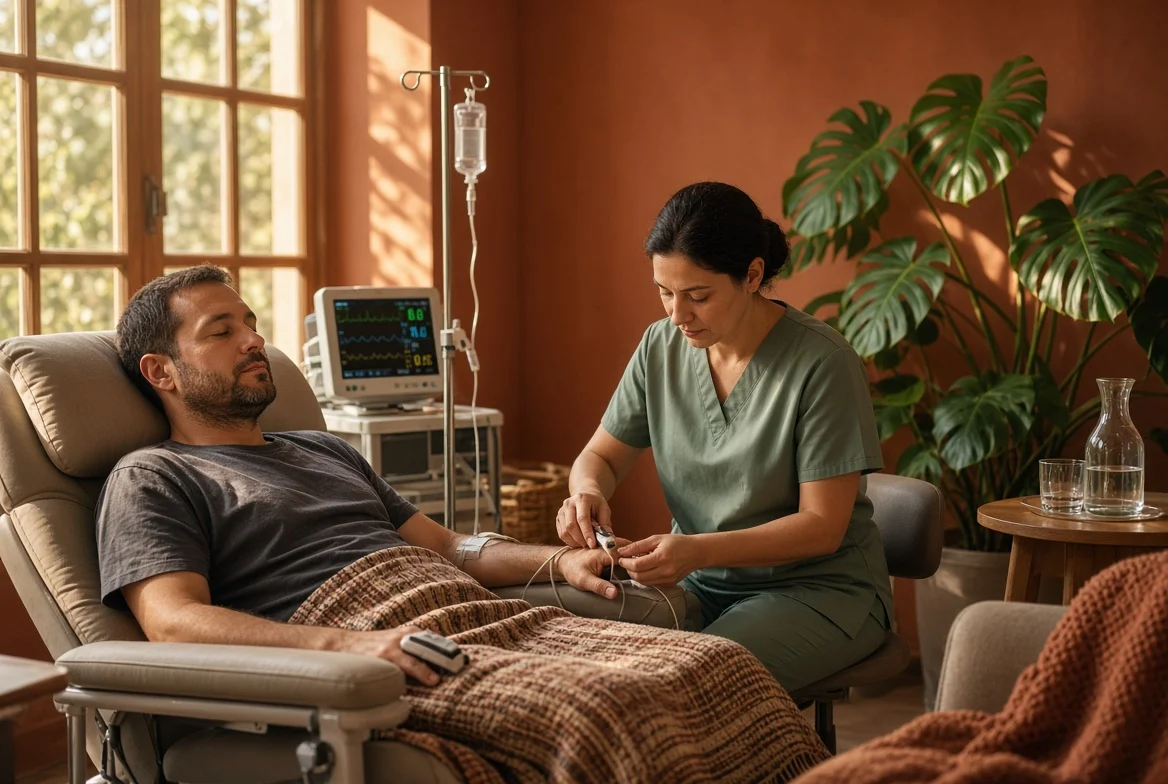
The short answer
What is ibogaine treatment for alcohol addiction?
Ibogaine treatment for alcohol addiction is a single physician-supervised dose of ibogaine hydrochloride, given in a licensed medical facility under continuous cardiac monitoring, only after alcohol withdrawal has been medically completed. At Ibogaine Treatment MX it runs as an inpatient program in Mexico City for $12,500, with 90 days of clinical follow-up. The published human evidence for alcohol is thinner than it is for opioids, and this page says so rather than working around it. It is not a cure, it is not approved by the FDA, and it is not given to anyone whose liver, electrolytes or EKG fall outside written thresholds.
| What is treated | Alcohol dependence, including daily drinking, binge patterns with physical dependence, and cases with previous failed detoxes. |
|---|---|
| The order it happens in | Medically supervised detox first, then re-screening against thresholds, then 1 supervised dose. Never the other way round. |
| Why detox is not optional | Alcohol withdrawal can cause seizures and delirium tremens. Ibogaine is not given during withdrawal under any circumstances. |
| Program length | 7 nights is the baseline. Alcohol cases often need longer, because detox runs before the treatment clock starts. |
| Cost | $12,500, the same as every other dependence we treat. Extra nights are billed at the nightly rate printed on your quote. |
| Screening before travel | 12-lead EKG read by our cardiologist, a liver panel, potassium and magnesium, drinking history, and any history of withdrawal seizures. |
| The extra test alcohol can trigger | An echocardiogram, when the cardiologist wants to rule out alcohol-related heart muscle damage. |
| Who is in the room | A cardiologist, an emergency physician and an ACLS-trained nurse, 1 nurse to 1 patient, through the session and the night. |
| Legal status | Not a scheduled substance in Mexico. Schedule I in the United States. Not FDA approved anywhere. |
| Strength of the evidence | Weaker than for opioids. Animal studies plus case reports and small observational series. No randomised controlled trial. |
The sequence
Why detox has to finish before a dose is possible.
This is the single biggest difference between an alcohol case and an opioid case. With opioids, withdrawal is managed and then interrupted. With alcohol, withdrawal has to be finished and the body brought back into range before ibogaine enters the picture at all.
Stage 1
Withdrawal is a medical event
Alcohol withdrawal is not the same category of problem as opioid withdrawal. It can produce seizures and delirium tremens, and it is managed by a physician with the nurse on site through the night.
Stage 2
The body is brought back into range
Heavy drinking depletes potassium, magnesium and thiamine, and low electrolytes make ibogaine’s effect on the heart worse. Repletion happens here, not on the dosing day.
Stage 3
Everything is measured again
A repeat EKG and a repeat liver panel, read against the same written thresholds we approved you on. Detox changes these numbers, sometimes for the better.
Go or no-go decisionStage 4
Only then, 1 dose
The same dosing protocol as every other patient: 3 clinicians in the room, continuous 12-lead ECG and pulse oximetry, and overnight telemetry afterwards.
If stage 3 says the liver has not recovered enough, the answer is “not yet” and you are not billed for a treatment you did not receive. That happens, and it is a better outcome than the alternative.
What we measure
3 organs alcohol damages, and ibogaine depends on.
Opioid screening is mostly a cardiac question. Alcohol screening is 3 questions, because alcohol and ibogaine put load on the same organs from opposite directions.
Organ 1
The heart
Ibogaine blocks the hERG potassium channel, which delays repolarisation and prolongs the QT interval. Long-term heavy drinking can separately weaken heart muscle, a condition called alcoholic cardiomyopathy.
Those are 2 unrelated problems arriving at the same organ, which is why the cardiologist may ask for an echocardiogram on an alcohol case when they would not on an opioid case.
Threshold: a QTc above our written number, conduction disease, or structural damage on the echo is a no.
Organ 2
The liver
The liver enzyme CYP2D6 converts ibogaine into noribogaine. A liver working under damage from years of drinking does that conversion less predictably, which makes the dose harder to reason about.
AST, ALT, GGT and bilirubin all have written thresholds. Unlike the heart findings, liver values often improve after a supervised detox and a few sober weeks, which turns some no answers into yes.
Threshold: values above our written numbers after detox and a recheck is a no. Before that, it is a not yet.
Organ 3
The brain
Heavy drinking depletes thiamine, and untreated thiamine deficiency in a dependent drinker can cause lasting neurological damage. Repletion is standard care in any supervised alcohol detox and it happens here before anything else.
The psychiatrist also reviews psychiatric history at screening. A session that would destabilise an existing condition is a reason we decline, whatever the liver and the EKG say.
Threshold: active psychosis or mania is a no. Other history is reviewed case by case.
The question nobody answers
Benzodiazepines, and why they complicate an alcohol case.
This comes up on most alcohol screening calls, and the honest answer has 2 halves that sound like they contradict each other. They do not.
- Benzodiazepines are standard in alcohol detox. They are the usual medical tool for managing alcohol withdrawal safely, and a supervised detox may involve them. That is ordinary care, not a red flag.
- Benzodiazepine dependence is a separate matter. If you are dependent on benzodiazepines in your own right, that is a decline. Benzodiazepine withdrawal can cause seizures and a safe taper is measured in months, which ibogaine does not shorten.
- The 2012 forensic review flagged both. The published review of ibogaine-associated deaths named alcohol and benzodiazepine withdrawal seizures among the hazards. That paper is the direct reason detox is sequenced before dosing here rather than run alongside it.
- If both are true for you, the order is fixed. The benzodiazepine has to be tapered under your own doctor before we can screen you for the alcohol dependence. We will tell you that on the first call rather than after a deposit.
Tell us about every benzodiazepine on the screening call, prescribed or not. It changes the plan, and finding out on arrival wastes a flight.
The stay
A stay that may run longer than 7 days.
The 7-day program is the same one every patient does. What is different for alcohol is that detox may sit in front of it. We would rather print that here than surprise you with it on day 2.
Day 1 · Arrival
Assessment, not admission paperwork
Private driver from MEX Terminal 1. Repeat 12-lead EKG, repeat liver panel and electrolytes, and a direct conversation about your last drink and any previous withdrawal seizures. This decides how long detox will take, and therefore how long you are here.
Days 1 to 3 · Detox
Supervised, with a nurse on site overnight
Withdrawal is managed by the physician, not endured in a room. Thiamine, potassium and magnesium are replaced. Length depends on your drinking history, which is why this block is a range rather than a fixed day.
Re-screen
The go or no-go, made on new numbers
A fresh EKG and a fresh liver panel against the written thresholds. A yes moves you to dosing. A not yet means we wait and recheck. A no means the deposit is refunded in full and we help you get home.
Dosing day
1 dose, 3 clinicians, continuous monitoring
A cardiologist, an emergency physician and an ACLS-trained nurse in the room. Continuous 12-lead ECG and pulse oximetry through the session and overnight. Crash cart and oxygen at the bedside, hospital 9 minutes away under a written transfer agreement.
Day after · Telemetry
Monitored past the point it feels finished
Overnight telemetry and a morning EKG compared against your baseline. Noribogaine is still active well after the session ends, which is why nobody is discharged the day after dosing.
Recovery · Discharge
The psychiatrist, then a written summary
Daily physician rounds and a morning EKG. The psychiatrist plans the 90 days, including who at home hears from us. You leave with a written clinical summary for your own doctor, the follow-up dates, and a US referral list.
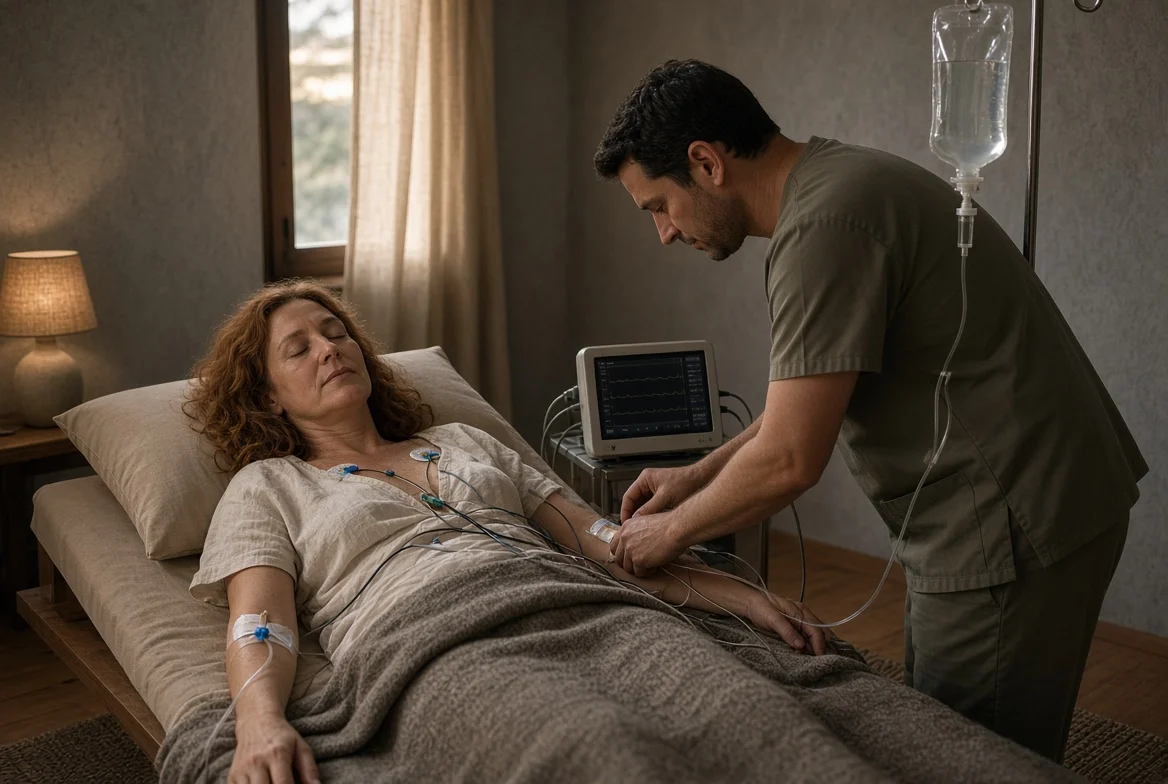
Only the extra nights are billed, at the nightly rate printed on your quote before you book. The $12,500 program price does not change because your detox took longer.
The evidence
Where the evidence for alcohol is thinner, stated plainly.
We publish the opioid numbers because opioid studies exist. For alcohol they mostly do not, and a clinic that quotes you an alcohol success rate is quoting something nobody has measured.
What exists
Animal studies showing reduced alcohol intake
Preclinical work has repeatedly shown ibogaine reducing alcohol self-administration in animals. That is the strongest signal in the alcohol literature, and it is the reason the treatment is offered at all.
Does not show: that the same effect occurs in people, at what dose, or for how long. Animal results do not transfer automatically to humans.
What exists
Case reports and small observational series
Human accounts of ibogaine in alcohol dependence exist as case reports and small uncontrolled series rather than trials, often alongside other substance use.
Does not show: a rate of anything. No control group, no randomisation, and no standardised follow-up you could compare across clinics.
What does not exist
A randomised controlled trial
There is no published randomised controlled trial of ibogaine for alcohol dependence. In 2025 the State of Texas funded $50 million of FDA-supervised ibogaine trials led by UTHealth Houston with UTMB Health, set up through 2026.
Those trials will take years to report. Until they do, nobody can tell you a 12-month figure for alcohol, including us.
What we can stand behind
The safety record of the sequence
Medically supervised alcohol detox has a known safety record. Continuous cardiac monitoring during dosing has a known safety record. What we can promise is the protocol and who is in the room, not an outcome.
The forensic review of ibogaine-associated deaths is summarised on the what we treat page.
Saying this costs us patients. It is still the only defensible thing to put on a medical page, and it is the same standard we apply to the opioid evidence on the opioid page.
Who we decline
The alcohol cases we turn away.
Some are permanent. Some are a “not yet” that becomes a yes once a value comes back into range, and with alcohol that happens more often than with any other dependence we treat.
- Alcohol-related heart muscle damage on the echocardiogram. A permanent no. The heart cannot take the load ibogaine puts on it.
- Liver values that stay above threshold after a supervised detox and a recheck. Before the recheck this is a not yet, and it is worth waiting for.
- A history of withdrawal seizures our facility is not equipped to manage. This is about matching the case to the setting, not about how serious your drinking is.
- Benzodiazepine dependence in your own right. Taper under your own doctor first, then come back to us.
- A QTc above our written threshold, or conduction disease on the EKG. Correctable causes are a not yet. Structural findings are a no.
- Electrolytes that will not stay in range after repletion and a recheck.
- Active psychosis or mania, or a psychiatric history our psychiatrist judges the session would destabilise.
- Pregnancy or breastfeeding, and anyone under 18. No exceptions.
The complete list, including conditions we do not treat at all, is on what we treat.
After discharge
The 90 days, and the problem that is specific to alcohol.
Opioid patients go home to a substance they have to seek out. Alcohol patients go home to one that is in every supermarket, every restaurant and most family occasions. That difference shapes the follow-up.
Say this out loud to whoever is going home with you
Do not restart drinking to taper yourself down.
If drinking resumes after treatment, going back to a heavy daily pattern re-establishes physical dependence, and stopping again without supervision puts you back in front of the same seizure risk you were just walked through. Nobody should manage a second alcohol withdrawal alone at home.
If it happens, the answer is a call to your own physician or to us, not a plan to handle it privately. That is on the first follow-up call, it is in the written summary that goes to your doctor, and it is the reason the calls are scheduled with dates before you leave.
Days 1 to 30
Weekly calls
A clinician calls every week on a scheduled day. Sleep, appetite, mood and craving are tracked, because a change in any of them tends to show up before anything else does.
Days 45, 60, 90
Psychiatrist milestone calls
Longer calls with the psychiatrist who saw you here. Day 60 matters most, because that is when support from everywhere else has usually faded.
Handover
Your own clinician, from discharge
A written clinical summary goes to your physician, including your liver values so they have a baseline to re-test against. Plus a US referral list, with no fee paid in either direction.
Common questions
Ibogaine and alcohol dependence, answered plainly.
Most alcohol cases are decided by a liver panel and an EKG, which is why the screening call exists. These are the answers we can give before it.
Can I have ibogaine while I am still drinking?
No. Ibogaine is never given during alcohol withdrawal or while you are still drinking. Withdrawal has to be medically completed first, and your electrolytes and liver values have to meet written thresholds. Any clinic willing to dose you before that is skipping the step that keeps the treatment survivable.
Do I need to detox before I fly, or do you do it there?
Either, and it is decided on the screening call. Some people detox at home under their own doctor before travelling, which shortens the stay. Others detox here under our physician on the first days. What is not an option is detoxing alone without supervision, at home or anywhere else.
Does ibogaine cure alcohol addiction?
No, and the evidence for alcohol is weaker than for opioids. Animal studies show reduced alcohol intake, and human evidence is case reports and small series rather than trials. We can tell you the protocol and who is in the room. We cannot tell you a success rate, because nobody has measured one to a standard worth quoting.
Will my liver disqualify me?
It might, and it might not, and the difference is usually time. AST, ALT, GGT and bilirubin have written thresholds because the liver converts ibogaine into noribogaine. Values often improve after a supervised detox and some sober weeks, so a first result above threshold is frequently a “not yet” rather than a “no”. We re-test rather than guess.
I take benzodiazepines. Can I still be treated?
It depends which situation you are in. Benzodiazepines used as part of a supervised alcohol detox are ordinary medical care. Being dependent on benzodiazepines in your own right is a decline, because that withdrawal can cause seizures and a safe taper takes months that ibogaine does not shorten. Tell us about every one on the first call.
Why might my stay be longer than 7 days?
Because detox sits in front of the 7-day program rather than inside it. How long it takes depends on your drinking history and how your values respond. Only the extra nights are billed, at the nightly rate printed on your quote, and the $12,500 program price does not change.
Is it cheaper than treating an opioid dependence?
No. The price is $12,500 for every dependence we treat, because the clinical team, the monitoring and the follow-up are identical. The only variable is extra nights if detox extends the stay. The pricing page itemises the whole figure and lists the 5 exclusions.
What happens if you decline me?
You get the reason in plain language, in writing. Any deposit is refunded in full, including if we decline you after you have arrived. Where we can, we refer you to a clinician near you from the same US list we give patients we do treat. Nobody is passed to another clinic for a fee.
Screening costs nothing
Find out where your liver and your heart actually stand.
3 questions on the contact page. A physician or nurse calls you back within 1 business day and tells you which tests to order at home. The answer comes in writing, whether it is yes, not yet, or no.