
Key takeaways
- Ibogaine changes your body first. In a survey of 88 people treated in Mexico, 80% said it ended or sharply cut their opioid withdrawal.
- The largest measured change shows up around 1 month. In a 12-month study of 30 people, half reported no opioid use at 1 month, and drug-use scores stayed better after that without matching the 1-month result.
- We found no published study that measured personality before and after ibogaine. What lasts gets built in the 90 days after treatment, which is why our follow-up runs to day 90.
Ibogaine does change people, in ways researchers can measure. The catch is timing: the changes run on different clocks, so any answer to “does ibogaine change you” needs a date attached. Most of the people who write to us are a parent or a partner. They’ve heard that someone came back from Mexico a different person, and they want the plain version: what changes, how fast, and for how long. This article lines up 7 published studies against that question and shows how our 7-day program is built around the answer.
Ibogaine changes 3 things on 3 clocks. Your body changes in days: withdrawal eases, and in some people the heart’s reset between beats slows for a day or more. Cravings, drug use and mood change over weeks, with the strongest published results at 1 month. Habits change over months, if at all, and that part gets built after the clinic.

What changes, and when
The changes arrive in order: body first, then cravings and mood, then habits. Here is what 7 studies measured, lined up against that timeline.
| When | What changed | What the study found | Study |
|---|---|---|---|
| First days | Opioid withdrawal | 80% of 88 patients said ibogaine ended or sharply cut their withdrawal | Davis and colleagues, 2017 |
| Day 1 to day 2 | Heart rhythm (QT interval) | In 6 of 14 patients, the QT stayed prolonged for more than 24 hours after the dose | Knuijver and colleagues, 2022 |
| 1 month | Opioid use | 15 of 30 people reported no opioid use in the previous 30 days | Brown and Alper, 2018 |
| 1 month | PTSD, depression, anxiety | Symptoms fell 88%, 87% and 81% on average in 30 veterans | Cherian and colleagues, 2024 |
| After treatment | Brain activity | Veterans whose thinking improved tended to show stronger theta waves on EEG | Stanford team, 2025 |
| 3 months or more | Cravings | 25% of 88 patients said their cravings stayed lower for at least 3 months | Davis and colleagues, 2017 |
| 12 months | Drug use and depression | Scores were still lower in the 8 people who finished every interview | Noller and colleagues, 2018 |
| Later, self-reported | Coping and inner life | People who did well reported more inner peace and less unhealthy anger | Renn and colleagues, 2018 |
The 7 studies cover 5 groups of people, because 2 of them reanalyze earlier data. None had a control group, and the largest included 88 people. They show what changed for the people studied. They can’t tell you the odds for one person.
The first 72 hours: your body
The first change is physical, and it comes fast. For people with opioid dependence, withdrawal eases in the days after the dose. In a survey of 88 patients treated in Mexico, 80% said ibogaine ended or sharply cut it, and 72% of them had used opioids for 4 years or longer.
Balance goes for a while too. A Dutch hospital study recorded severe unsteadiness (ataxia) that wore off, so nobody walks unassisted on dosing day in our facility.
The session itself
We don’t describe the dosing day in detail on this site. It’s different for each person, and it belongs in a conversation with a physician, so ours walks each patient and family through it on day 2, before consent. In broad terms, people describe a long, dreamlike stretch of memories and images, then a quieter stretch of thinking it over. The effects can last 24 hours or more.
Your heart rhythm, for a day or more
This is the change nobody feels and the one we watch most closely. Ibogaine makes the heart take longer to reset between beats. An EKG shows this as a longer QT interval, and a corrected QT (QTc) above 500 ms is the range doctors treat as high risk for a dangerous rhythm.
When researchers at a Dutch university hospital gave 14 patients a single dose, the QTc rose 95 ms on average at its peak. 7 of the 14 crossed 500 ms. In 6 of the 14, it stayed above 450 ms for more than 24 hours after the dose. The study described the change as reversible.
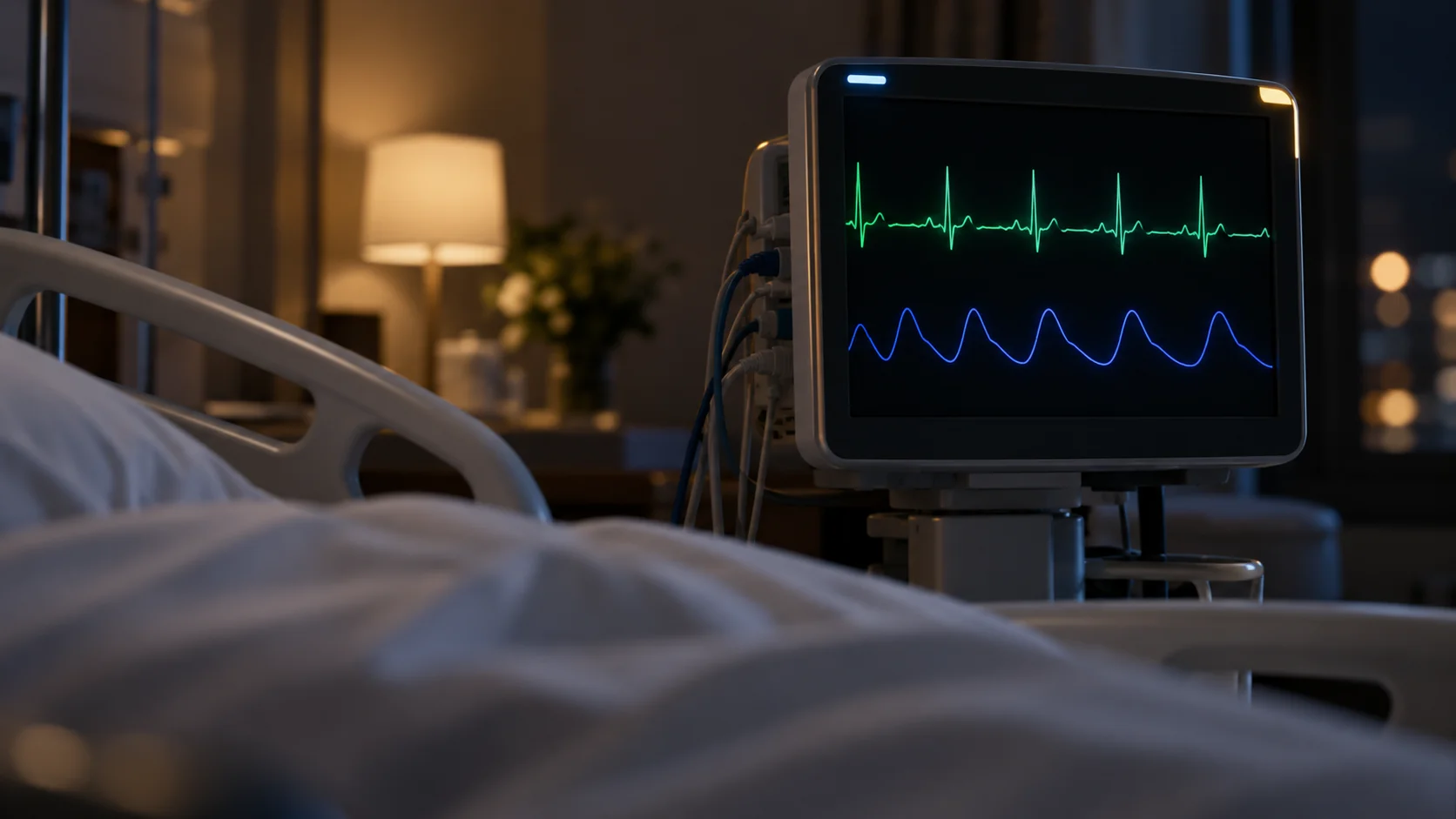
That timing is the reason day 4 of our program is a monitoring day. A cardiologist compares a morning EKG against your baseline, there’s an EKG every morning after that, and discharge is on day 7. You can see who’s in the room at each stage.
What this means for screening. Because the heart change can last past the session, screening starts at home: a 12-lead EKG, potassium, magnesium and a liver panel, read by our cardiologist against written thresholds before anyone books a flight. The most common reason we say “not yet” is a medication, and coming off methadone or Suboxone takes a planned washout with your prescriber. Have the full medication list ready for the first call.
What changes in the first month?
Cravings, drug use and mood move the most in the first month, and that’s where the published numbers look strongest. In a 12-month study of 30 people, 15 of them reported no opioid use at all in the 30 days before their 1-month check-in. In the survey from Mexico, half said their cravings dropped.
The biggest 1-month numbers come from Stanford’s veterans study. 30 special operations veterans with traumatic brain injuries were treated with ibogaine plus magnesium at a clinic in Mexico. Their average score on a standard disability scale fell from 30.2 to 5.1, and their PTSD, depression and anxiety symptoms fell 88%, 87% and 81% on average. Tests showed better concentration and memory, and nobody in the group had a heart problem.
2 limits apply to every number here. The groups were small, and nobody got a placebo. And 1 month is either where the study stopped or where its results peaked. If you’re still sorting out what ibogaine treats, read these as the best case on record.
Does ibogaine change you for good?
For some people, yes, but the change is front-loaded. It’s largest around 1 month and smaller after that, and what keeps it in place gets built after treatment.
In the 30-person study, drug-use scores improved most at 1 month. They stayed better than before treatment through month 12 but never matched the 1-month result. Among the 88 survey respondents, 50% said cravings dropped, while 25% said the drop lasted 3 months or more. 30% said they never used opioids again, and 41% reported more than 6 months without opioids at the time of the survey.
The longest follow-up comes from New Zealand, where ibogaine treatment is legal. Researchers there tracked 14 people for 12 months after a single treatment. Among the 8 who completed every interview, drug-use and depression scores were still lower at 12 months. 1 enrolled patient died during treatment. Risk and benefit come from the same dose.
Our position is that ibogaine opens a window, and the first month is the widest part of it. What happens inside that window decides what you keep. So our 7-day program ends with 90 days of scheduled follow-up: weekly calls to day 30, then calls at days 45, 60 and 90. Day 60 gets extra attention, because that’s usually when support from everyone else has faded.

Does ibogaine change your personality?
Not in any way research has measured. We couldn’t find a published study that tested personality traits before and after ibogaine. What people describe is narrower, and more useful to know.
A 2018 analysis of 73 people from that Mexico survey compared those who did well with those who didn’t. Those who did well reported lasting changes in how they handle hard feelings: more ability to sit with painful emotions, better coping with stress, less unhealthy anger, and more inner peace and joy. In the full survey, people who did well also had the lowest depression and anxiety scores and rated the experience as more spiritually meaningful.
2 cautions go with this. These are self-reports from people looking back, and the people who stayed well are the ones describing the most change. And when depression lifts, people answer personality questions differently, so “I’m a different person” and “I feel better” are hard to tell apart.
Our read: when ibogaine helps, it looks less like a new personality and more like a bigger gap between a hard feeling and acting on it. That gap is real, and it needs practice to last.
What brain scans show as of 2026
Brain activity changes after ibogaine in ways researchers can record, and those changes track with who got better. Whether they last is unknown.
In July 2025, the Stanford team published EEG and MRI results from 30 veterans, building on its 2024 study. Those whose planning and decision-making improved tended to show stronger theta waves, a rhythm the researchers think may help the brain adapt. Those whose PTSD symptoms dropped tended to show less complex activity in the cortex, which the team thinks may calm an overactive stress response.
That’s a pattern in 30 people. It doesn’t prove rewiring. The chemistry behind it, from noribogaine, a metabolite that stays in the body for days, to growth-factor changes in rats, is still being worked out.
What ibogaine leaves unchanged
Ibogaine doesn’t change the life you go home to. The supply, the people, the prescriptions and the stress are all still there on day 8.

It doesn’t change your heart’s underlying risks either, which is why screening comes first and some people get a no. We decline more cases than we accept. We also publish no success rate, because nobody in this field can prove one to a standard we’d accept.
What it can change is how the first weeks feel and how much room you have to choose differently in them. The year is mostly decided at home, in the weeks after the calls from everyone else stop. That’s the part we plan with you on days 5 and 6 with a psychiatrist, and you leave with a written summary for your doctor at home.
If the question is “does ibogaine change you,” the published studies point to clear change in the first month and a smaller, less certain change after that. What decides the rest is the 90 days after, and a heart that passes screening first. If you’re weighing this for yourself or someone you love, the first step is a screening call: 3 questions, a callback from a physician or nurse within 1 business day, and nothing billed before screening.
Questions people ask
Does ibogaine change you permanently?
No study has shown a permanent change. The longest follow-ups stop at 12 months, and none of them had a control group. In a 12-month study of 30 people, drug-use scores improved most at 1 month and stayed better, though less so, through month 12.
Does ibogaine change your personality?
We couldn’t find a published study that measured personality traits before and after ibogaine. In a 2018 analysis of 73 patients treated in Mexico, those who did well reported better coping with stress, less unhealthy anger and more inner peace. Those are self-reports from people who stayed well, so they describe what changed for them. They can’t predict what will change for you.
How long do the effects of ibogaine last?
The session lasts 24 hours or more, and the heart change can last past the first day: in 6 of 14 patients in a Dutch study, the QT was still prolonged after 24 hours. In a survey of 88 patients, 50% said cravings dropped, and 25% said the drop lasted at least 3 months.
Does ibogaine change your brain?
It changes brain activity in ways researchers can record. In 30 veterans studied at Stanford, those whose thinking improved tended to show stronger theta brain waves, which the researchers think may help the brain adapt. It’s a small study with no control group, and nobody has shown permanent rewiring in humans.
Does ibogaine change you for the worse?
It can. The main risk is to the heart: in a 2022 Dutch hospital study, 7 of 14 patients reached a QTc above 500 ms, the range linked to dangerous rhythms, and in a New Zealand outcome study, 1 enrolled patient died during treatment. Screening, a cardiologist and overnight monitoring come before anything else for that reason.
Will I still want to use after ibogaine?
Cravings often drop at first and can come back. In a survey of 88 patients, 50% said ibogaine reduced their cravings, and 25% said the drop lasted 3 months or more. Our follow-up calls are scheduled before you leave, with dates, for exactly this.
Sources
- Davis AK, Barsuglia JP, Windham-Herman AM, Lynch M, Polanco M. Subjective effectiveness of ibogaine treatment for problematic opioid consumption: short- and long-term outcomes and current psychological functioning. Journal of Psychedelic Studies. 2017;1(2):65-73. doi:10.1556/2054.01.2017.009
- Knuijver T, Schellekens A, Belgers M, Donders R, van Oosteren T, Kramers K, Verkes R. Safety of ibogaine administration in detoxification of opioid-dependent individuals: a descriptive open-label observational study. Addiction. 2022;117(1):118-128.
- Brown TK, Alper K. Treatment of opioid use disorder with ibogaine: detoxification and drug use outcomes. American Journal of Drug and Alcohol Abuse. 2018;44(1):24-36. doi:10.1080/00952990.2017.1320802
- Cherian KN, Keynan JN, Anker L, and colleagues. Magnesium-ibogaine therapy in veterans with traumatic brain injuries. Nature Medicine. 2024;30:373-381. doi:10.1038/s41591-023-02705-w
- Stanford Medicine research team led by Nolan Williams. EEG and MRI analysis of 30 veterans treated with magnesium-ibogaine. Nature Mental Health. Published 24 July 2025. doi:10.1038/s44220-025-00463-x
- Noller GE, Frampton CM, Yazar-Klosinski B. Ibogaine treatment outcomes for opioid dependence from a twelve-month follow-up observational study. American Journal of Drug and Alcohol Abuse. 2018;44(1):37-46. doi:10.1080/00952990.2017.1310218
- Renn E and colleagues. A mixed-method analysis of persisting effects associated with positive outcomes following ibogaine detoxification. Journal of Psychoactive Drugs. 2018;50(4):287-297.
This article is information, not medical advice. Ibogaine is not approved by the FDA and carries cardiac risk. Whether it is an option for you is decided by a physician after an EKG and blood tests, never by an article. If you or someone else is in danger now, call your local emergency number.