
Key Takeaways
- Brain reactions to cocaine cues can peak 1 to 6 months after quitting.
- Felt craving fades sooner, so feeling fine isn’t proof you’re safe.
- A relapse after months off is riskier: 78.6% of U.S. cocaine overdose deaths in 2021 also involved an opioid.
Cocaine cravings come back months later because the brain holds on to cocaine cue memories long after the drug leaves the body, and those memories can get stronger during the first months off cocaine before they fade. So if you’re 2, 3 or 6 months in and searching “why do cocaine cravings return months later,” the first thing to know is that a craving at month 4 doesn’t mean you’ve relapsed. It means you’ve reached the stretch that research marks as the riskiest.
A text from an old contact, cash on payday or a hard week at work can bring back a pull that feels as strong as the first week. Stress turns it up.
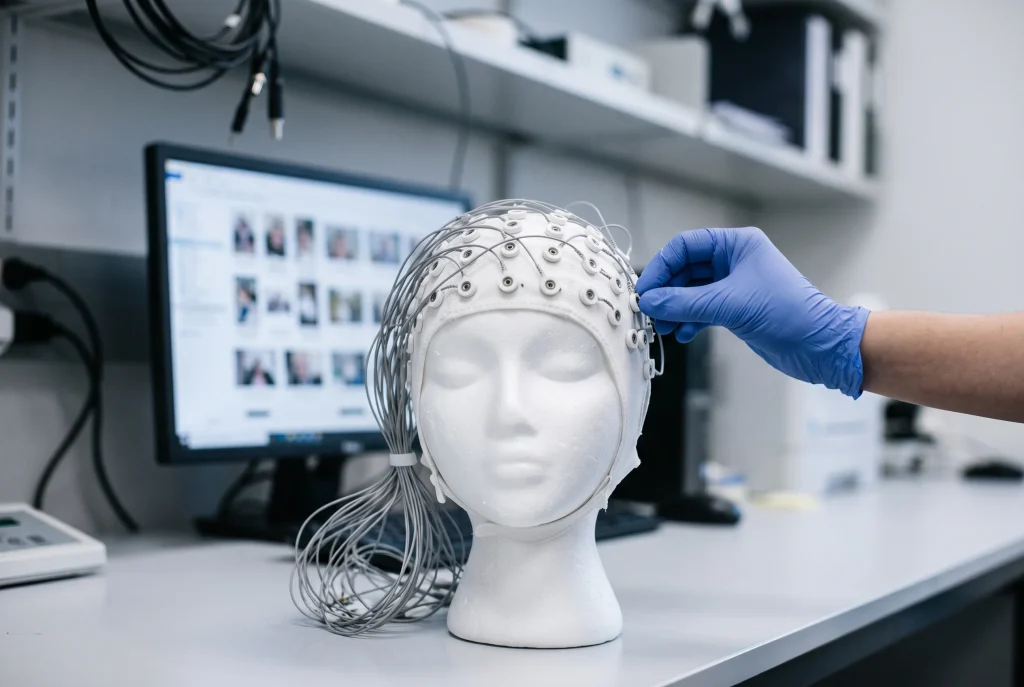
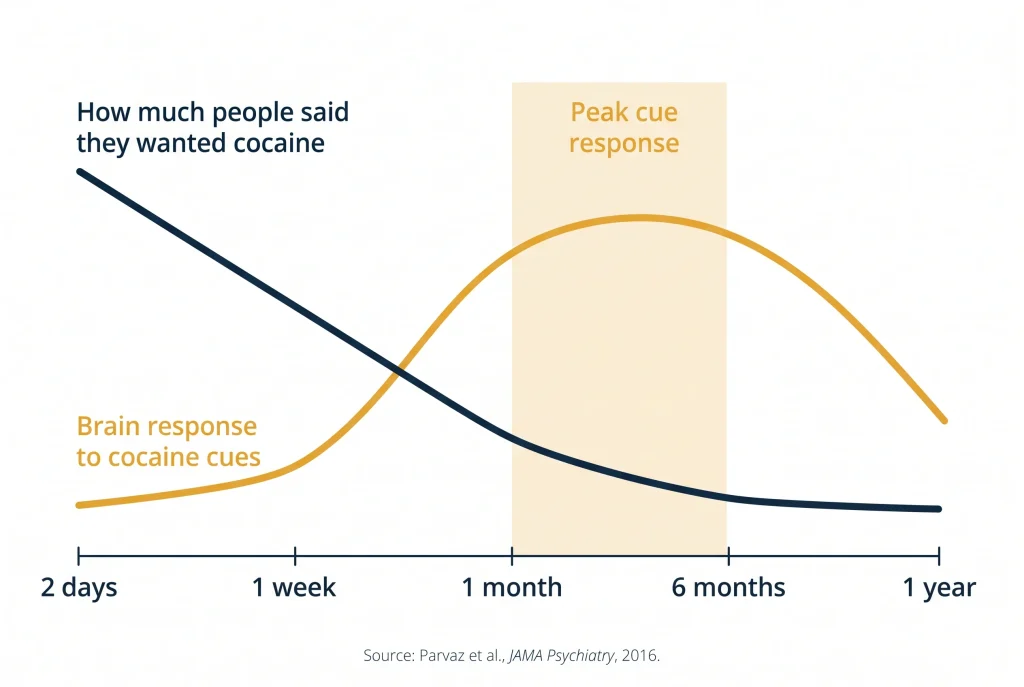
Researchers call this incubation of craving. In a 2016 JAMA Psychiatry study, 76 adults addicted to cocaine looked at cocaine photos while an EEG tracked their brain response. That response was highest in people 1 to 6 months off cocaine, lower at 2 days and 1 week, and lower again at 1 year.
What Is The Incubation Of Cocaine Craving?
Incubation of craving is the pattern where cue-triggered craving grows during the first weeks and months without a drug, peaks, then declines. It showed up first in rats trained on cocaine, and a 2016 EEG study found the same shape in people.
In 2001, a rat study published in Nature and announced by the National Institute on Drug Abuse (NIDA) tested animals that had learned to press a lever for cocaine. During testing, the lever delivered nothing. The rats’ response to cocaine cues grew across 60 days of withdrawal. The cue alone drove the pressing.
The human study came in 2016. Researchers grouped 76 adults addicted to cocaine by how long they’d been off it: 2 days, 1 week, 1 month, 6 months or 1 year. Each person viewed photos of cocaine being prepared and used while an EEG recorded the late positive potential, a brain wave that rises when something grabs attention. That brain response was strongest in the 1-month and 6-month groups.
People’s own ratings told the opposite story. On a 0 to 5 scale, how much participants said they wanted cocaine fell from about 3.4 at 2 days to 1.0 at 6 months. They felt less pull while their brains reacted more. The authors concluded that people may be most vulnerable to relapse between 1 and 6 months off cocaine, and the least aware of it. NIDA’s write-up of the study adds that this is roughly when most people leave treatment.
That’s 1 study of 76 people, and the authors want it repeated before anyone uses EEG as a relapse test. It matches the rat data, though, and it explains how a craving can land right when life starts to feel normal.
How Cues And Stress Make Cocaine Cravings Return Months Later
Cues replay the memory of using, and stress makes the brain more likely to act on it. A 2011 review in Current Psychiatry Reports by Yale’s Rajita Sinha lists stress and drug cues among the most common reasons people give for relapse.
Cues work through dopamine. In a 2006 Journal of Neuroscience brain-scan study of 18 people addicted to cocaine, a staged video of people buying, preparing and smoking crack raised dopamine in the dorsal striatum, a part of the brain tied to habits. The bigger the dopamine rise, the stronger the craving people reported. Nobody in the scanner took cocaine. The video was enough.
Cues are personal: an old contact’s name on a screen, cash in your pocket on payday, a song from using nights, a bar bathroom, the hour you used to start.
Stress stays wired longer than people expect. Sinha’s review describes stress hormone systems that stay out of balance for at least 4 to 12 weeks after acute withdrawal ends. In her lab’s studies, people leaving inpatient cocaine treatment whose stress hormones jumped higher during a lab stress test went on to use more cocaine over the next 90 days.
Alcohol is its own trigger. A drink lowers the guard you’ve built, and for people who used cocaine and alcohol together, the first drink can be the cue. If drinking has turned into its own dependence, it needs its own plan, and alcohol addiction treatment starts with a supervised detox.
The Craving Clock: When Cravings Peak And When They Fade
Cocaine cravings don’t fade in a straight line. Felt craving drops fastest in the first month, while the brain’s reaction to cues climbs until somewhere between month 1 and month 6, then eases by 1 year.
| Time off cocaine | What people tend to feel | What the research shows | What it means for the plan |
| Days 1 to 7 | The crash: exhaustion, low mood, strong wanting | Self-rated wanting at its highest, about 3.4 out of 5 at day 2 | Sleep, eat, and keep someone close if mood drops |
| Weeks 2 to 4 | Mood lifts and the urge gets quieter | Wanting down to about 1.5 out of 5 by 1 month | Relief isn’t safety, so keep the routine |
| Months 1 to 6 | Fewer urges, then sudden strong pulls around cues | Brain cue response at its highest; studies across drugs report relapse as high as 65 to 70% in the 90 days after treatment | The riskiest months: keep follow-up calls and the written plan |
| Month 6 to year 1 | Cravings rarer and shorter | Brain cue response lower at 1 year | Cues can still fire, so keep the plan simple |
| Years later | Most people are out of dependence | 99.2% lifetime chance of remission; half reach it within about 5 years | A craving now is an old memory firing |
The middle row is the trap. Month 3 often feels like the hard part is over, and the 2016 data says the brain disagrees. The 90 days of follow-up in our program cover that window, with weekly calls to day 30, then milestone calls at days 45, 60 and 90.
The bottom row matters too. In U.S. national survey data published in Addiction in 2011, 408 people with a history of cocaine dependence had a 99.2% lifetime chance of remission, and half reached remission within about 5 years of onset. Remission there means no longer meeting the criteria for dependence, which isn’t the same as never using again.
Is A Craving At Month 3 A Sign Of Relapse?
A craving at month 3 is not a relapse. A craving is a signal and relapse is the act of using, but strong, frequent cravings do raise the odds, so act on them early.
Sinha’s review cites research where higher craving during abstinence predicted a faster return to cocaine. At a publicly funded clinic affiliated with Yale, records on 878 patients showed fewer than 1 in 4 of those whose main drug was cocaine were abstinent at discharge. Alcohol and opioid patients, who also got medications, did better, though still under 35%.
The plan for the next hour matters more than the craving itself. And because felt craving and brain response split apart in the 2016 study, a quiet month isn’t proof you’re in the clear either.
Why a Relapse After Months Off Carries More Risk
A relapse after months off carries more risk because most cocaine overdose deaths involve an opioid too, and any opioid tolerance a person once had drops during time away.
CDC’s National Center for Health Statistics counted 24,486 U.S. overdose deaths involving cocaine in 2021, and 78.6% of them also involved an opioid. DEA lab testing found fentanyl in about 1% of the cocaine samples it analyzed for 2024, so most of that overlap points to people using both drugs. A single contaminated bag can still kill.
Cocaine is also hard on the heart. A 1999 study in Circulation found heart attack risk climbs sharply in the hour after cocaine use. Mixing cocaine with alcohol forms cocaethylene, which lasts longer in the body than cocaine and is harder on the heart. That’s why a heart screen by our medical team comes first for anyone with a cocaine history.
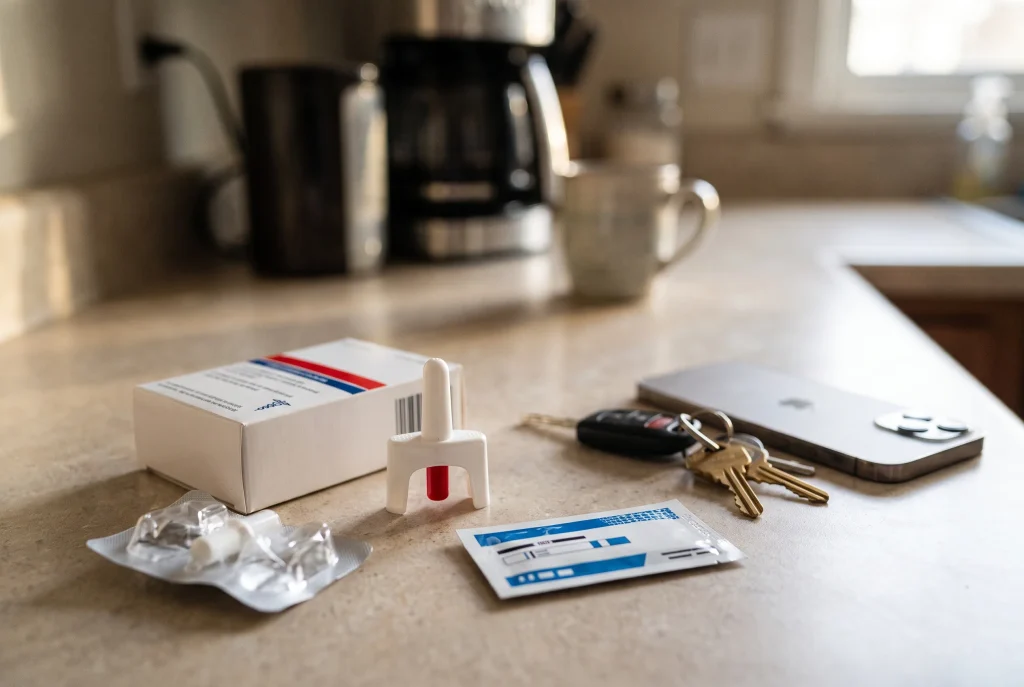
If a relapse is possible, keep naloxone (Narcan) where people can find it, and don’t use it alone. Fentanyl test strips can check a sample for fentanyl before anyone uses it. Planning for a possible relapse keeps people alive long enough to try again.
What Treatment Works For Cocaine Cravings In 2026?
No medication is approved for cocaine use disorder as of 2026, so treatment for cravings is behavioral, and contingency management is where the trial evidence points first.
A 2026 Journal of Addiction Medicine paper puts the number of Americans with cocaine use disorder at 1.4 million and notes there’s still no FDA-approved treatment. Contingency management pays people in vouchers or small prizes for drug-free urine tests. A 2018 PLOS Medicine review of 50 trials covering 6,942 people with cocaine or amphetamine addiction found that contingency management paired with the community reinforcement approach had fewer dropouts than usual care at 12 weeks and at the end of treatment.
Cognitive behavioral therapy works on the next hour: spot the cue, delay, leave, call.
Medication research hasn’t stopped. A pilot trial listed on ClinicalTrials.gov, with a January 2026 start date, is testing semaglutide alongside therapy and measuring how strongly the brain reacts to cocaine cues. Ibogaine sits outside that evidence base for now, and the science on how ibogaine affects the brain is still early.

Where Ibogaine Fits, And Where The Data Stops
Ibogaine has early data on cocaine craving, and that data stops at 1 month, before the window this article is about.
A 2018 open-label study in Frontiers in Pharmacology reported on 89 people treated for cocaine dependence at a 12-bed clinic in St. Kitts. Average craving intensity on the Minnesota Cocaine Craving Scale fell from 5.51 at admission to 1.47 at discharge, and sat at 1.96 at 1 month among the 25 people who reported back. Depression scores fell from 14.3 to 4.2 by discharge. There was no control group, most patients weren’t measured after discharge, and the lead author disclosed a financial interest in a company developing ibogaine.
We haven’t found a published study that tracks cocaine craving after ibogaine through month 3 or month 6, the months where incubation peaks. At Ibogaine Treatment MX, we treat that as an open question, and anything medical that comes up on a follow-up call goes to our psychiatrist the same day.
Cocaine also changes our screening. We run a urine drug screen on arrival, and our cardiologist asks for an echocardiogram when the history warrants it. Whether someone gets a yes, a not yet or a no for ibogaine for cocaine addiction depends on that heart screen first.
What Should You Do When A Craving Hits Months Later?
Write the plan down before the craving starts, then follow it step by step when it does.
- Say it out loud or text it to someone: “I’m craving.” Naming it gets it out of your head.
- Put 30 minutes between the craving and any decision. Set a timer.
- Get away from the cue. Leave the bar, delete the number, hand the cash to someone you trust.
- Call 1 person who knows your plan. If you’re in follow-up, tell the person running your calls.
- Check the basics: hungry, angry, lonely or tired. Fix the 1 you can fix in the next hour.
- Skip the first drink.
- If you use it anyway, don’t use it alone, keep naloxone nearby, and tell someone on your treatment team the next day. A lapse gives the plan new information.
If the crash brings thoughts of suicide, call or text 988 in the U.S. For free, confidential treatment referrals at any hour, SAMHSA’s National Helpline is 1-800-662-4357.
Frequently Asked Questions
Why do cocaine cravings return months later?
Cue memories tied to cocaine can grow stronger during the first months off the drug, a pattern researchers call incubation of craving. A 2016 EEG study of 76 adults found the brain’s response to cocaine photos was highest after 1 and 6 months without cocaine. Stress and alcohol can set those memories off.
Is it normal to crave cocaine after 6 months?
Yes. In the 2016 EEG study, brain reactions to cocaine cues were still high at 6 months and lower at 1 year. A craving at 6 months is a signal to use your plan, and it doesn’t mean you’ve relapsed.
Do cocaine cravings return months later even if you feel fine?
They can. In the same study, how much people said they wanted cocaine fell from about 3.4 to 1.0 on a 0 to 5 scale by 6 months, while their brain response to cues stayed high. Feeling fine is good news, and it’s also the time to keep your follow-up calls going.
Do cocaine cravings ever go away?
For most people, yes. In U.S. national survey data on 408 people with a history of cocaine dependence, the lifetime chance of remission was 99.2%, and half reached it within about 5 years of onset. Remission there means no longer meeting the criteria for dependence.
Is there a medication for cocaine cravings?
Not an approved one. As of 2026, no FDA-approved medication exists for cocaine use disorder, which a 2026 Journal of Addiction Medicine paper puts at 1.4 million people in the U.S. Trials of drugs such as semaglutide are underway, and contingency management is where the evidence points today.
Can ibogaine stop cocaine cravings?
A 2018 open-label study of 89 people treated in St. Kitts reported average craving intensity falling from 5.51 at admission to 1.47 at discharge, with no control group. Follow-up ended at 1 month, and we haven’t found published craving data for months 2 to 6, when incubation peaks. Anyone with a cocaine history starts with a heart screen before ibogaine is on the table.
When To Call For Help
Call for help when cravings come back more often, last longer or start shaping your plans for the week. If the question “why do cocaine cravings return months later” keeps coming up for you or someone you love, talk to our team about whether outpatient care, a stay with us or both fits right now.
Sources
- Parvaz MA, Moeller SJ, Goldstein RZ. Incubation of cue-induced craving in adults addicted to cocaine measured by electroencephalography. JAMA Psychiatry. 2016;73(11):1127-1134. doi:10.1001/jamapsychiatry.2016.2181
- Grimm JW, Hope BT, Wise RA, Shaham Y. Incubation of cocaine craving after withdrawal. Nature. 2001;412(6843):141-142. doi:10.1038/35084134
- National Institute on Drug Abuse. EEG indicates that cocaine relapse vulnerability peaks 1 to 6 months into abstinence. NIDA Notes. September 2017.
- Sinha R. New findings on biological factors predicting addiction relapse vulnerability. Current Psychiatry Reports. 2011;13(5):398-405. doi:10.1007/s11920-011-0224-0
- Volkow ND, Wang GJ, Telang F, Fowler JS, Logan J, Childress AR, and colleagues. Cocaine cues and dopamine in dorsal striatum: mechanism of craving in cocaine addiction. Journal of Neuroscience. 2006;26(24):6583-6588. doi:10.1523/JNEUROSCI.1544-06.2006
- Lopez-Quintero C and colleagues. Probability and predictors of remission from life-time nicotine, alcohol, cannabis or cocaine dependence: results from the National Epidemiologic Survey on Alcohol and Related Conditions. Addiction. 2011.
- Spencer MR, Miniño AM, Garnett MF. Co-involvement of opioids in drug overdose deaths involving cocaine and psychostimulants, 2011-2021. NCHS Data Brief No. 474. Hyattsville, MD: National Center for Health Statistics; 2023.
- Drug Enforcement Administration, Office of Forensic Sciences. CY 2024 Annual Cocaine Report (PRB-2025-42). Published 22 September 2025.
- Mittleman MA and colleagues. Triggering of myocardial infarction by cocaine. Circulation. 1999.
- van Amsterdam J, Gresnigt F, van den Brink W. Cardiovascular risks of simultaneous use of alcohol and cocaine: a systematic review. Journal of Clinical Medicine. 2024;13(5):1475. doi:10.3390/jcm13051475
- Characteristics of ongoing clinical trials for cocaine use disorder registered on global clinical trial databases. Journal of Addiction Medicine. July/August 2026.
- De Crescenzo F, Ciabattini M, D’Alò GL, De Giorgi R, Del Giovane C, Cassar C, and colleagues. Comparative efficacy and acceptability of psychosocial interventions for individuals with cocaine and amphetamine addiction: a systematic review and network meta-analysis. PLOS Medicine. 2018;15(12):e1002715. doi:10.1371/journal.pmed.1002715
- Repurposing semaglutide for the treatment of cocaine use disorder: a pilot mechanistic study. ClinicalTrials.gov identifier NCT07227948. Study starts 20 January 2026.
- Mash DC and colleagues. Ibogaine detoxification transitions opioid and cocaine abusers between dependence and abstinence: clinical observations and treatment outcomes. Frontiers in Pharmacology. 2018;9:529. doi:10.3389/fphar.2018.00529
This article is information, not medical advice. Ibogaine is not approved by the FDA and carries cardiac risk. Whether it is an option for you is decided by a physician after an EKG and blood tests, never by an article. If you or someone else is in danger now, call your local emergency number.