Effective treatments for methamphetamine use disorder start with contingency management. It rewards people with vouchers or prizes each time a urine test shows no meth. Mexico’s 2025 national treatment guide stresses it, and the main US guideline calls it the standard of care. No medicine is approved for this disorder, but 2 off-label medicines have cut meth use in trials.
That matters in Mexico, where methamphetamine, known here as cristal, now drives more treatment requests than any other drug. CONASAMA is the federal commission for mental health and addictions. It reported that amphetamine-type stimulants, mostly meth, made up 49.1% of treatment demand in 2023. In 2013 the figure was 9.5%.
We run an ibogaine clinic in Mexico City, and ibogaine isn’t on the list of proven options. No published study has given ibogaine to a group of people with methamphetamine use disorder and reported the results. So this guide ranks what works by its best trial, ours included. It also shows what happens when people who use meth ask us for ibogaine. We turn down a higher share of them than of people who use opioids, because of the heart risks covered below.
What Are The Most Effective Treatments For Methamphetamine Use Disorder?
Contingency management has the strongest evidence, and 2 medicines used off-label come next. The ASAM/AAAP clinical practice guideline in the US says contingency management has shown the best results of any treatment studied. Mexico’s 2025 treatment guide, written with CONASAMA, reaches the same point. It says psychosocial treatment is what has worked, with an emphasis on contingency management.
That’s a change from 2006. Back then, an NIH news release called the Matrix Model the therapy thought to work best for meth. It’s a 16-week outpatient program built around group therapy, and Mexico’s guide still recommends it for stimulant users in first-level care. It helps while people are in it. In the largest trial, though, its edge over usual care was gone at follow-up.
Other talk therapies, such as cognitive behavioral therapy (CBT), help people stay in treatment and use less while they’re in it. Exercise and mindfulness programs have done more for mood than for meth use. In a 2017 trial across 9 residential programs, exercise helped drug use only in people who kept it up. A mindfulness trial found less depression and anxiety but no change in meth-free urine tests.
Every Treatment Option, Ranked by trial
Contingency management ranks first, 2 off-label medicines come next, and ibogaine has no data in meth. The table shows the largest or best-designed trial we found for each option, and what the result leaves out.
| Treatment | Best trial | People | What happened | The catch |
| Contingency management | Roll and colleagues, 2006 | 113 | More drug-free urine samples; people stayed off meth longer, about 5 weeks vs 3 | Gains shrink after rewards stop, and few clinics offer it |
| Bupropion plus naltrexone | ADAPT-2, 2021 | 403 | 13.6% responded vs 2.5% on placebo over 12 weeks | Most people didn’t respond; an injection every 3 weeks plus daily pills |
| Mirtazapine | McKetin and colleagues, April 2026 | 344 | Use fell by 7.0 days out of 28 vs 4.8 on placebo at 12 weeks | Use was self-reported; drowsiness in 47% vs 33% |
| Matrix Model | Rawson and colleagues, 2004 | 978 | More meth-free urine tests during treatment than usual care | The edge over usual care was gone at follow-up |
| Exercise | STRIDE, 2017 | 302 | Drug use improved only in people who kept up the exercise | A small effect that depends on sticking with it |
| Sertraline | Shoptaw and colleagues, 2006 | 229 | No benefit, and people stayed in treatment less | The authors advised against it for meth |
| Ibogaine | None in meth | 0 | No published human study in methamphetamine use disorder | Heart risk; no clear rules for it in Mexico |
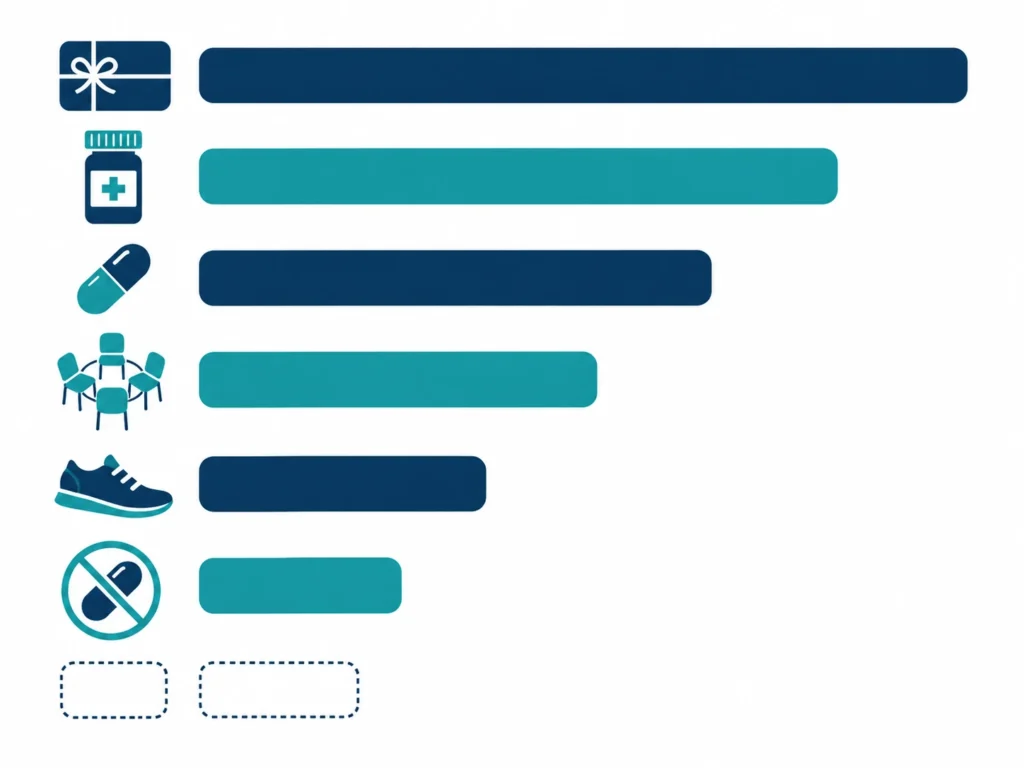
Even the best results are modest. And ibogaine has no results in meth at all, because no one has published a trial.
How Does Contingency Management Work?
You and the program agree on 1 target, usually a urine test with no meth in it. Each time you hit it, you get a reward on the spot. Rewards can be vouchers, gift cards or draws for prizes, and they often grow with each negative test in a row.
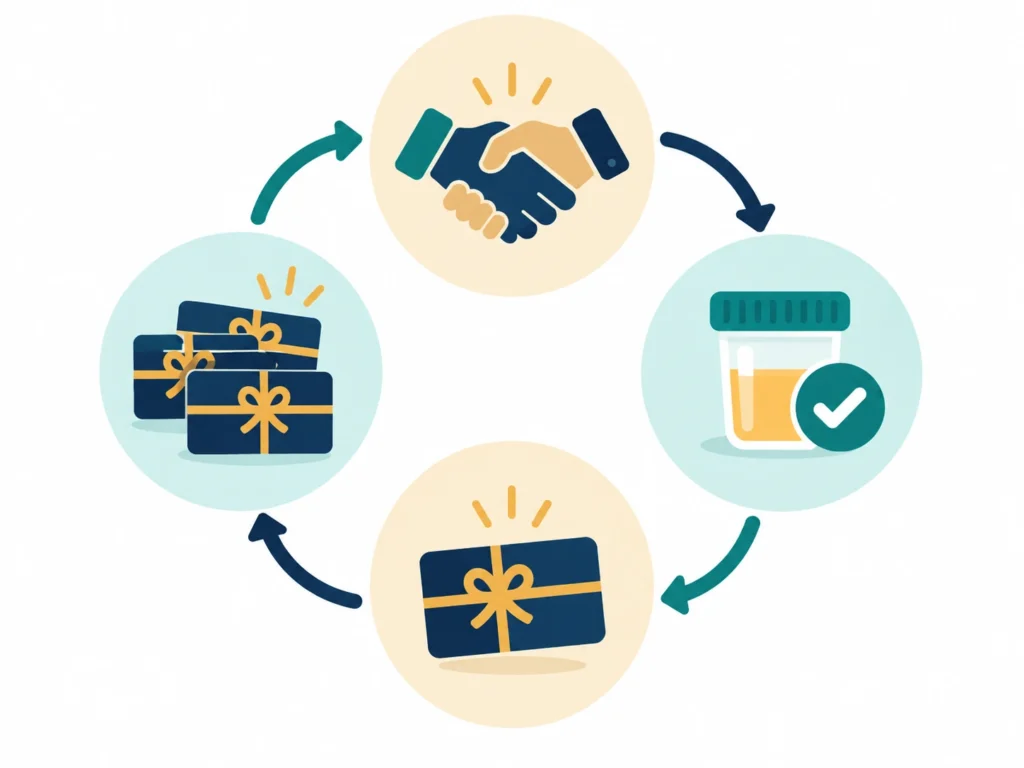
In Spanish it’s called manejo de contingencias. Mexico’s guide describes it as rewarding steps such as showing up and sticking with treatment. The reward can be real or symbolic. It’s also part of the Matrix Model and of the community reinforcement approach, which is in CONASAMA’s 2025 national treatment standards.
The evidence for meth goes back to 2006. In a trial of 113 people with meth problems, adding contingency management to usual care produced more drug-free urine samples. People stayed off meth for about 5 weeks, against 3 with usual care alone.
The weak spot is what happens when the rewards stop. In a 2006 trial that compared contingency management with CBT, urine results no longer differed between the groups at follow-up. Longer programs help. A 16-week trial of 118 people compared different lengths. Those who got 4 months of contingency management stayed off meth longer than those who got 1 month.
Before you choose a program in Mexico, ask 3 questions. What earns a reward? How often are you tested? How many weeks does it run?
Is There a Medication for Methamphetamine Use Disorder?
Not an approved one, in Mexico or the US. Mexico’s 2025 guide says no medicine is in routine use for it, apart from antipsychotics for crises and other mental health problems. Doctors can still prescribe some medicines off-label. The ASAM/AAAP guideline lists bupropion, mirtazapine, topiramate and naltrexone.
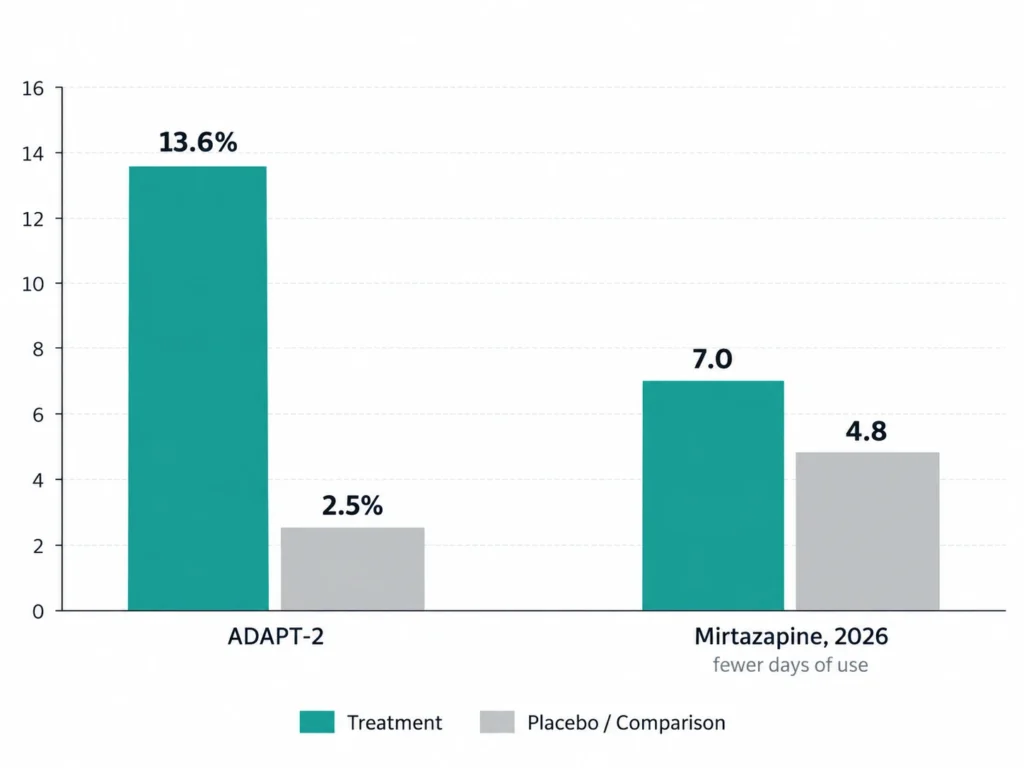
Bupropion plus naltrexone has the biggest trial behind it. In ADAPT-2, 403 adults got either a naltrexone injection every 3 weeks plus daily bupropion pills, or placebo. A response meant at least 3 of 4 urine tests free of meth. Over 12 weeks, 13.6% responded on the medicines and 2.5% on placebo. That’s about 1 extra responder for every 9 people treated. The researchers called the response low but higher than placebo.
In Mexico, naltrexone is sold as a 50 mg tablet with a prescription. ADAPT-2 tested the long-acting injection, not the tablet, and we found no sign that the injection is sold here.
Mirtazapine is a generic antidepressant, taken each evening in the latest trial. It now has 3 placebo-controlled trials behind it, and Mexico’s guide calls the mirtazapine and topiramate results moderate. The first 2 trials, with 60 and 120 people, were in San Francisco. Both enrolled only men or transgender women who have sex with men. In the 120-person trial, meth-positive urine tests fell by a third at 12 weeks.
The largest trial, published April 1, 2026, enrolled 344 adults at 6 clinics in Australia, and 37% were women. After 12 weeks, people on mirtazapine used meth on 7.0 fewer days out of 28, against 4.8 fewer on placebo. Drowsiness hit 47% on mirtazapine and 33% on placebo. The main result also relied on what people reported themselves.
One antidepressant backfired. In a 229-person trial, people on sertraline stayed in treatment less. The authors concluded it shouldn’t be used for meth dependence. Mexico’s guide notes that stimulant medicines such as lisdexamfetamine and methylphenidate are being studied in Sweden and the Czech Republic. A 2026 JAMA patient guide says only addiction specialists should prescribe stimulants for this.
Do You Need Detox for Methamphetamine Use Disorder?
Sometimes, detox alone isn’t a treatment. Meth withdrawal mostly brings depression, anxiety, irritability, poor sleep and craving. NIDA says symptoms peak 2 to 3 days after the last use and may last about a week. Low mood, anxiety and craving can run for months after that.
Those later months are where people slip. The ASAM/AAAP guideline tells clinicians to check for depression, anxiety, insomnia and paranoia in the weeks and months after stopping. Left untreated, they raise the risk of using again. A detox stay that ends after the first week can’t cover that stretch.
Supervised detox does make sense for anyone who is suicidal or psychotic. It’s also wise for people who depend on alcohol or benzodiazepines as well as meth, because quitting those can cause seizures.
Meth can also cause psychosis: seeing or hearing things that aren’t there, or holding false beliefs, even when sober. NIDA notes that heavy drinking and stress raise the odds that it comes back to someone who has had it before. For acute psychosis, Mexico’s guide points to benzodiazepines and antipsychotics, with frequent reviews of whether to continue them.
Treating Methamphetamine Use Disorder In Mexico
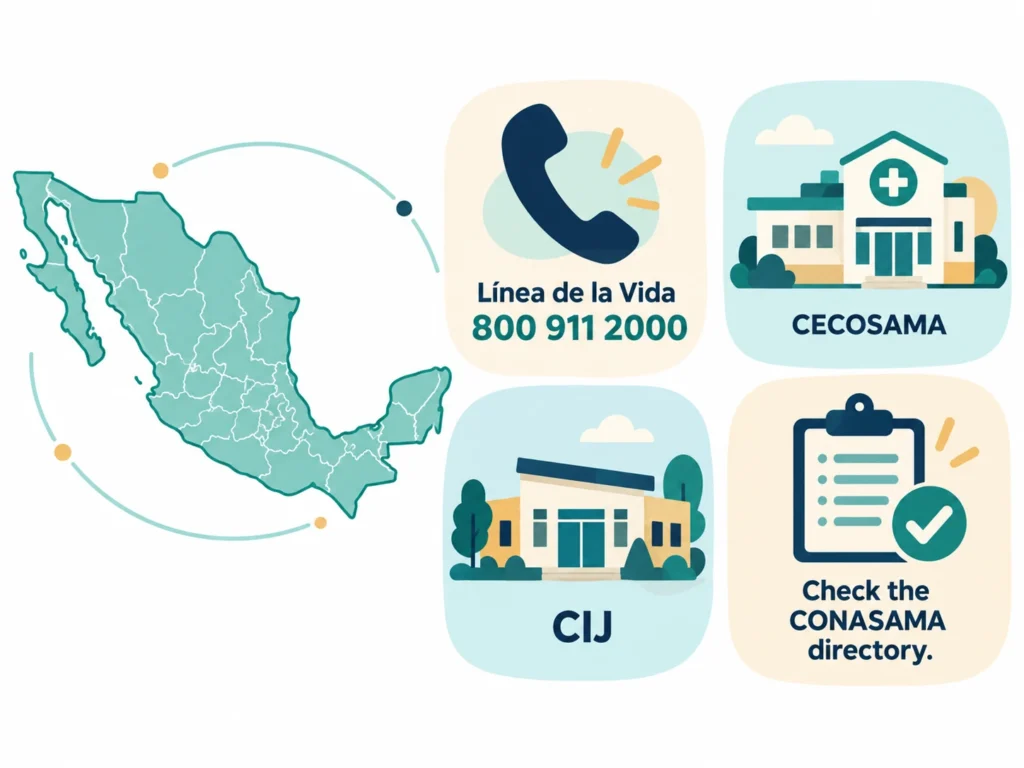
Start with the free public network. Mexico’s 2025 guide names 2 entry points: CECOSAMA community centers and Centros de Integración Juvenil (CIJ). Both offer screening, brief and outpatient treatment, and referral to other services.
CONASAMA counted 341 CECOSAMA centers in 2024. At CIJ, meth was the top drug behind treatment requests in 2024, at 35% of cases. For guidance by phone, call Línea de la Vida at 800 911 2000. It’s free, confidential and open 24 hours a day, all year. It can also refer you to a specialist center. In an emergency, call 911.
Meth isn’t the most used illegal drug in Mexico. In the 2025 national drug survey (Encodat), young people reported more recent use of cannabis and cocaine. Yet meth leads treatment demand, which CONASAMA’s report puts down to how fast it damages health.
How to check a residential center in Mexico?
Before you sign anything, look the center up in CONASAMA’s directory of recognized residential centers. A CONASAMA guide says only 277 of the more than 2,000 centers it found, or 13%, met the official standard for addiction treatment, NOM-028-SSA2-2009.
Mexico’s 2025 guide warns that a sizable share of centers run without valid health licenses or standard treatment protocols. It adds that some use force or punishment. Unregistered centers like these are often called anexos.
Under Mexican rules, holding someone in a center against their will requires a doctor’s order and a request from a family member. The center must also notify the public prosecutor (Ministerio Público). A person held this way can ask a judge to review it.
Before you agree to a stay, ask 4 things. Does CONASAMA recognize the center? Who is the doctor in charge? Is the stay voluntary? Does it offer contingency management or a Matrix-style program?
Ibogaine And Methamphetamine Use Disorder
There’s no published study of ibogaine in people with methamphetamine use disorder, so no one can say it works for meth. That includes us.
The nearest human data come from an open-label study of 89 people dependent on cocaine, another stimulant. They reported less craving after treatment. There was no comparison group. The rest is animal research. A 2016 review found ibogaine cut drug self-administration in animals, and it noted that human trials were missing. Much of what’s known about how ibogaine affects the brain comes from animal and lab studies rather than people.
Ibogaine isn’t a controlled substance under Mexico’s General Health Law. We also found no ibogaine medicine approved by COFEPRIS, the health regulator. Mexico’s 2025 guide puts ibogaine among psychedelic treatments still under study, with no clear rules yet.
The heart is our main worry. Long-term meth use is linked to heart failure, and ibogaine slows the heart’s electrical recharge between beats. That’s why our cardiologist screens stimulant users more strictly than opioid users. Their EKG is read against a lower QTc cutoff, and their heart history is checked back years. The cardiologist can also order an echocardiogram before any date is offered. Heart damage on that scan means no, whatever the EKG shows. For scale, FDA floated ideas for US ibogaine trials in October 2026. One would exclude anyone with a resting QTcF of 430 ms or more.
What happens when people who use meth ask us for Ibogaine?
Every answer comes in writing, with the reason: yes, not yet or no. A no comes from heart damage on the echocardiogram or a past heart event linked to stimulants. A QTc reading above our stimulant cutoff that can’t be corrected is also a no. A not yet comes from active psychotic symptoms, potassium or magnesium levels that need correcting, or fentanyl on the drug screen. Fentanyl moves the case to our opioid protocol first.
We don’t yet publish meth-specific counts of people screened, accepted or dosed, so this page can’t tell you how often the answer is yes. The research does show how hard ibogaine is on the heart. In a 2022 Dutch safety study, 7 of 14 opioid patients given a single 10 mg/kg dose had QTc readings above 500 ms. Nobody in that study developed torsades de pointes, the dangerous rhythm doctors watch for, but it’s why every dose needs heart monitoring.
Everyone we turn away gets a full refund of any deposit. We also tell them about the options at the top of this page, such as contingency management. Where we can, we refer them to a clinician near them, and we don’t send anyone to another clinic for a fee. Our rules for ibogaine treatment for methamphetamine spell out each check.
Using Less Still Counts
Quitting completely isn’t the only result that matters. Mexico’s 2025 guide says treatment goals can go beyond abstinence, to steps such as reducing harm and using less. NIDA reported in January 2024 that using less is a meaningful outcome for people with stimulant use disorders.
That’s how the 2026 mirtazapine trial measured success: about 2 fewer days of use in every 4 weeks, beyond placebo. Before you sign up anywhere, ask how the program measures progress.
Fentanyl And Cristal In Mexico
Mexico’s 2025 guide says fentanyl use here is concentrated in cities on the US border. Elsewhere, it turns up mostly mixed into other drugs. Tests of cristal have mostly come back clean. A project that checked 485 stimulant samples in Aguascalientes, Mexico City, Tijuana and Mexicali found no fentanyl. That isn’t a guarantee, though: at a 2022 music festival near Mexico City, testers found fentanyl in 14 of 22 MDMA samples.
In Mexicali, the forensic service found fentanyl in 20% of the bodies it tested from June 2022 to January 2025. Nearly all of those also had meth. Its director has noted that finding fentanyl in a body doesn’t mean it caused the death.
Naloxone reverses opioid overdoses, but in Mexico it’s still listed as a psychotropic and needs a prescription. A reform to change that cleared the Chamber of Deputies’ health committee in July 2026. At our last check, it still needed a vote of the full Chamber.
Our screening includes a drug test that looks for fentanyl. If it shows up, the plan changes, because opioid dependence needs its own withdrawal plan.
Choosing A Treatment For Someone You Love
Start with contingency management or a Matrix-style program, and ask a psychiatrist about bupropion with naltrexone or mirtazapine. Expect the work to take months. In Mexico, call Línea de la Vida at 800 911 2000 or go to a CECOSAMA or CIJ center.
In our view, these effective treatments for methamphetamine use disorder carry less risk than any ibogaine treatment, ours included. Your family member may still want to know whether ibogaine is an option. You can start a screening with their medical records, and a physician reviews them before any money changes hands. Screening is free and comes before any deposit, and a physician or nurse calls back within 1 business day.
Questions families ask about methamphetamine use disorder
What are the most effective treatments for methamphetamine use disorder?
Contingency management has the strongest evidence. The main US clinical guideline calls it the standard of care, and Mexico’s 2025 treatment guide stresses it too. 2 medicines used off-label have trial support: bupropion plus naltrexone, which helped 13.6% of people against 2.5% on placebo, and mirtazapine.
Is any medicine approved for methamphetamine use disorder in Mexico?
No. Mexico’s 2025 treatment guide says no medicine is in routine use for it, and none is approved in the US either. Doctors can prescribe some off-label. In a 344-person trial published in April 2026, mirtazapine cut meth use by 7.0 days out of 28, against 4.8 on placebo.
Where can I get free treatment for methamphetamine use disorder in Mexico?
Call Línea de la Vida at 800 911 2000, which is free and open 24 hours a day. You can also go to a CECOSAMA community center or a Centros de Integración Juvenil (CIJ) unit; CONASAMA counted 341 CECOSAMA centers in 2024. Both offer screening, outpatient treatment and referral.
How long does meth withdrawal last?
NIDA says symptoms peak 2 to 3 days after the last use and may last about a week. Low mood, anxiety and craving can continue for months. Treatment should cover those months, because untreated low mood and poor sleep raise the risk of using again.
Does ibogaine work for methamphetamine use disorder?
No one knows yet. No published study has tested ibogaine in people with methamphetamine use disorder; the nearest evidence is an open-label study of 89 people dependent on cocaine, plus animal research. Its evidence is stronger for opioid withdrawal, the most common of ibogaine’s uses. In Mexico, ibogaine isn’t a controlled substance, and we found no ibogaine medicine approved by COFEPRIS.
How long does treatment for methamphetamine use disorder take?
Most of the trials above ran 12 to 16 weeks. A 16-week trial of 118 people compared different lengths. Those who got 4 months of contingency management stayed off meth longer than those who got 1 month. Gains tend to shrink once rewards stop, so plan for months of support.
Sources
• American Society of Addiction Medicine and American Academy of Addiction Psychiatry. The ASAM/AAAP Clinical Practice Guideline on the Management of Stimulant Use Disorder. Journal of Addiction Medicine. 2024;18(1S Suppl 1):1-56.
• Piñeiro López NE, Borràs Cabacés T, Martínez Oró DP. Guía de tratamiento centrada en la persona y basada en la evidencia para trastornos por uso de fentanilo y metanfetamina en México. COPOLAD III, CONASAMA and Episteme Social. November 2025.
• Comisión Nacional de Salud Mental y Adicciones (CONASAMA). Informe sobre la situación de la salud mental y el consumo de sustancias en México 2024. Secretaría de Salud, 2024.
• CONASAMA. Guía para la operación de establecimientos privados que brindan atención residencial a las adicciones. Secretaría de Salud.
• CONASAMA. Lineamientos para el reconocimiento y ratificación de establecimientos especializados en adicciones en modalidad residencial. 2021.
• Encodat 2025. Prevalencias y factores asociados al consumo de drogas ilegales en población joven de México. Salud Pública de México. 2026.
• Centros de Integración Juvenil. Incremento del consumo de metanfetaminas: un desafío para los servicios de tratamiento. Revista Internacional de Investigación en Adicciones. 2024.
• Detección de fentanilo en estimulantes y reducción de daños en ciudades de México: resultados de una intervención piloto desde Aguascalientes. Cultura y Droga. 2024;29(38):171-197.
• García de Loera A, García de Loera L, Arredondo J, González-Nieto P. Fentanyl detection on stimulants and harm reduction in cities of Mexico: outcomes of a pilot intervention from Aguascalientes. Abstract, Harm Reduction International Conference (HR25), 2025.
• First drug-checking study at an electronic festival and fentanyl detection in the central region of Mexico. Harm Reduction Journal.
• Servicio Médico Forense de Baja California. Figures reported by El Imparcial, October 24, 2024 and March 14, 2025.
• Trivedi MH, et al. Bupropion and naltrexone in methamphetamine use disorder. New England Journal of Medicine. 2021;384(2):140-153.
• McKetin R, et al. Mirtazapine for methamphetamine use disorder: a randomized clinical trial. JAMA Psychiatry. Published online April 1, 2026. doi:10.1001/jamapsychiatry.2026.0159.
• Coffin PO, Santos GM, Hern J, et al. Effects of mirtazapine for methamphetamine use disorder among cisgender men and transgender women who have sex with men: a placebo-controlled randomized clinical trial. JAMA Psychiatry. 2020;77(3):246-255.
• Colfax GN, Santos GM, Das M, et al. Mirtazapine to reduce methamphetamine use: a randomized controlled trial. Archives of General Psychiatry. 2011;68(11):1168-1175.
• Roll JM, Petry NM, Stitzer ML, et al. Contingency management for the treatment of methamphetamine use disorders. American Journal of Psychiatry. 2006;163(11):1993-1999.
• Roll JM, Chudzynski J, Cameron JM, Howell DN, McPherson S. Duration effects in contingency management treatment of methamphetamine disorders. Addictive Behaviors. 2013;38(9):2455-2462.
• Rawson RA, McCann MJ, Flammino F, et al. A comparison of contingency management and cognitive-behavioral approaches for stimulant-dependent individuals. Addiction. 2006;101(2):267-274.
• Rawson RA, Marinelli-Casey P, Anglin MD, et al. A multi-site comparison of psychosocial approaches for the treatment of methamphetamine dependence. Addiction. 2004;99(6):708-717.
• Shoptaw S, Huber A, Peck J, et al. Randomized, placebo-controlled trial of sertraline and contingency management for the treatment of methamphetamine dependence. Drug and Alcohol Dependence. 2006;85(1):12-18.
• Trivedi MH, Greer TL, Rethorst CD, et al. Randomized controlled trial comparing exercise to health education for stimulant use disorder: results from the CTN-0037 STRIDE study. Journal of Clinical Psychiatry. 2017;78(8):1075-1082.
• Mash DC, Duque L, Page B, Allen-Ferdinand K. Ibogaine detoxification transitions opioid and cocaine abusers between dependence and abstinence: clinical observations and treatment outcomes. Frontiers in Pharmacology. 2018;9:529.
• Belgers M, et al. Ibogaine and addiction in the animal model, a systematic review and meta-analysis. Translational Psychiatry. 2016;6:e826.
• Knuijver T, et al. Safety of ibogaine administration in detoxification of opioid-dependent individuals: a descriptive open-label observational study. Addiction. 2022;117(1):118-128.
• National Institute on Drug Abuse. Methamphetamine. Research topic page, updated March 9, 2026.
• National Institute on Drug Abuse. Reduced drug use is a meaningful treatment outcome for people with stimulant use disorders. News release, January 10, 2024.
• National Institutes of Health. Incentive-based therapy improves outlook for methamphetamine abusers. News release, November 6, 2006.
• US Food and Drug Administration. Stimulant use disorders: developing drugs for treatment. Guidance for industry, May 2026.
• US Food and Drug Administration. Design and safety considerations for clinical trials involving ibogaine drug products; request for information. Federal Register, October 6, 2026. Docket FDA-2026-N-10429.
• JAMA Patient Page. What is methamphetamine use disorder? JAMA. 2026.
• Ley General de Salud (Mexico), Articles 234 and 245.
This article is information, not medical advice. Ibogaine is not approved by the FDA and carries cardiac risk. Whether it is an option for you is decided by a physician after an EKG and blood tests, never by an article. If you or someone else is in danger now, call your local emergency number.