
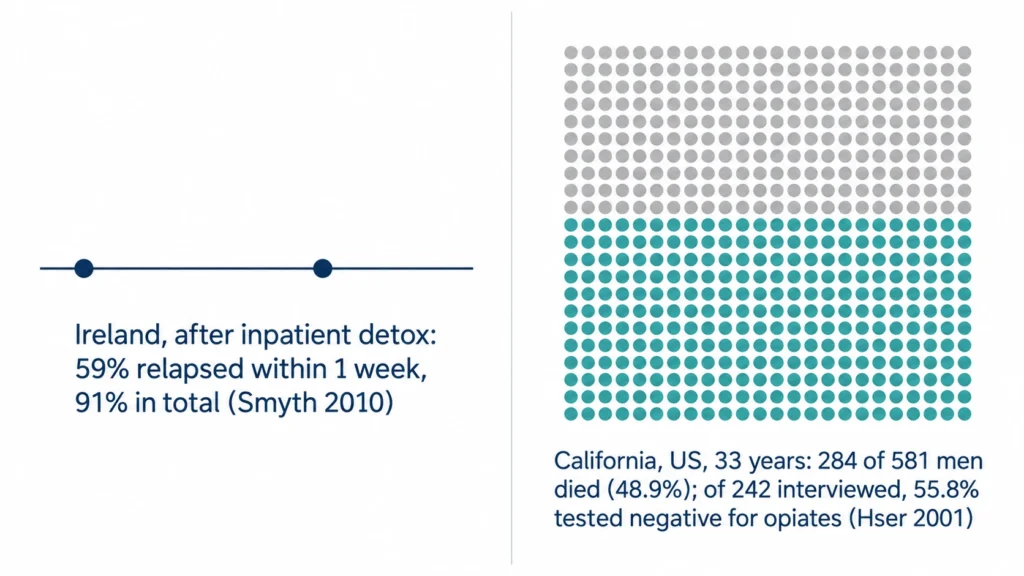
There’s no single heroin recovery rate. It depends on what counts as recovery and when you measure it. After inpatient detox in Ireland, 91% of patients went back to daily opiate use, 59% within a week. In a 33-year US study, 55.8% of the surviving men interviewed tested negative for opiates. But 48.9% of the 581 men had died.
We found no national heroin recovery rate for Mexico. Its national treatment data record who enters treatment, and we found no published follow-up of how people do afterward. Our clinic in Mexico City doesn’t publish a heroin recovery rate either. Studies from Ireland, the UK, Sweden and Mexico link the period right after detox or forced abstinence to high relapse and overdose risk. Ibogaine doesn’t change that. Time off opioids lowers tolerance, so a person’s old dose can stop their breathing.
What Is The Heroin Recovery Rate?
The heroin recovery rate is the share of people who stop or control heroin use, measured at a set point after treatment. Studies define it in different ways, so published figures run from under 10% to more than 50%.
4 words do most of the work. A lapse is any use after stopping. A relapse is a return to regular use, and the Irish study below counted only a return to daily use. Remission means a person no longer meets the diagnostic criteria for opioid use disorder. Recovery is the loosest term, because in some national surveys people decide for themselves whether they’re in it.
Ask which of the 4 a figure measures before you compare it with another.
What Is The Heroin Recovery Rate After Detox?
Low in the first weeks. An Irish study of people leaving inpatient detox found that 91% went back to daily opiate use, and 59% did so within a week.
The researchers interviewed 109 people admitted for detox in Ireland in 1995 and 1996. 99 of them had relapsed, and only 10, or 9%, hadn’t. 80% had used at least once within a month. Younger age, heavier heroin use, injecting and skipping aftercare all predicted an earlier relapse. People who finished the full 6-week program relapsed later.
Is The 40% to 60% Relapse Rate True For Heroin?
No. That figure covers alcohol and other drugs together, and it measures return to use within a year after treatment ends.
It comes from a 2000 review in the US medical journal JAMA by McLellan and colleagues, which compared addiction with high blood pressure and asthma, where 50% to 70% of patients relapse too. The authors were arguing that addiction behaves like other long-term illnesses. They weren’t measuring heroin.
The 80% and 90% heroin figures on other sites often come with no source. We traced 1 of those 80% figures to a study of schizophrenia patients in China. For heroin, the documented numbers are worse in the first month and better over decades, for the people who survive.
The Long-Term Heroin Recovery Rate: 33 Years Of Data
Among the men still alive and interviewed after 33 years, 55.8% tested negative for opiates. But 48.9% of the 581 men in the study had died by then.
UCLA researchers followed 581 men admitted between 1962 and 1964 to the California Civil Addict Program. It was a court-ordered treatment program for heroin-dependent offenders in the US. By the 1996 to 1997 interviews, 284 had died. A summary of the study by the US National Institute on Drug Abuse puts the death rate at 50 to 100 times what would be expected. Of the 242 men interviewed, 20.7% tested positive for heroin. Another 23.5% refused a urine test or were in jail or prison, so they weren’t tested.
Time off heroin mattered. 46.7% of the men interviewed had been off heroin for more than 5 years. The authors found that at least 5 years of abstinence considerably reduced the chance of relapse. It didn’t remove it: a quarter still relapsed even after 15 years. These men were in a compulsory program in 1960s California, so the study shows a direction. It can’t give anyone’s odds today.
Why Are The Weeks After Detox The Most Dangerous?
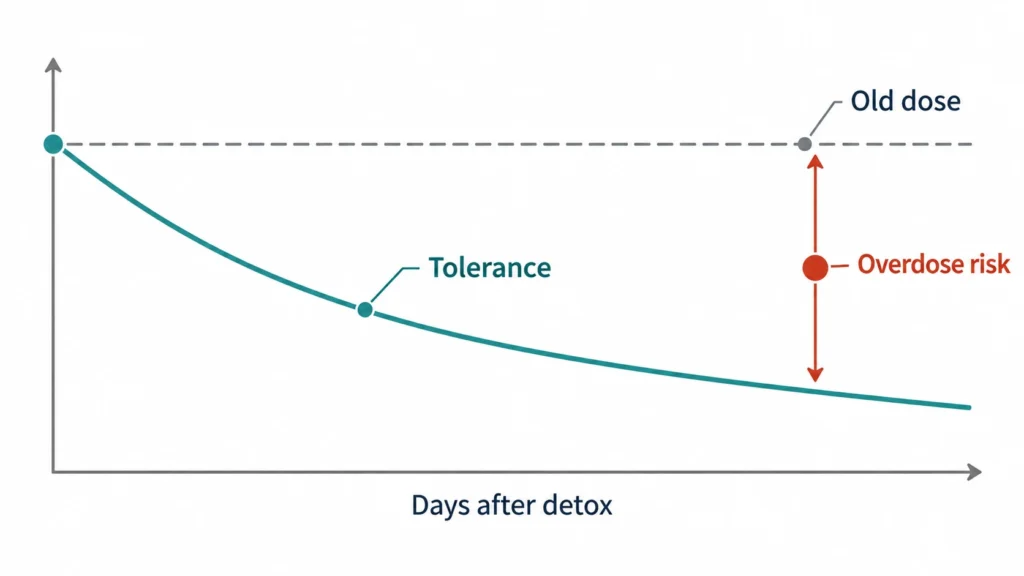
Tolerance falls after detox, but craving and easy access to heroin don’t. A dose that felt normal a month earlier can be enough to stop someone’s breathing.
Researchers in south London, in the UK, followed 137 people through a 28-day inpatient detox program. All 3 overdose deaths in the 4 months after discharge came from the 37 who finished both detox and the program. None of the 43 who left before finishing detox, still tolerant, died. 3 deaths is a small number, but larger studies point the same way.
A 2017 review in the BMJ pooled 19 cohort studies. It found 36.1 deaths per 1,000 person-years among people out of methadone treatment, against 11.3 among people in it. The 4 weeks after leaving treatment were among the riskiest. The same drop in tolerance follows when anyone stops methadone or buprenorphine.
A Swedish trial gave 40 people with heroin addiction counseling plus either a year of buprenorphine or a 6-day taper and then placebo. After a year, 75% of the buprenorphine group was still in treatment, and none had died. Everyone in the taper group had dropped out, and 4 of the 20 had died.
Mexico has its own version of this finding. Researchers in Tijuana followed 671 people who inject drugs from 2011 to 2017. Those recently put through involuntary drug treatment had 1.76 times the odds of a recent non-fatal overdose. The study can’t show why, but forced time off drugs followed by a return to use fits the same tolerance pattern.
Ibogaine doesn’t change this. It can cut withdrawal fast, and that’s the most consistent finding in the research on what ibogaine treats. But any treatment that keeps someone off opioids for days lowers their tolerance, which is why the tolerance warning is part of discharge at our clinic.
What we do about it at discharge
At discharge, every patient hears the tolerance warning, and so does whoever traveled with them. It’s written into the clinical summary for their own doctor and raised again on the first follow-up call. Naloxone at home is part of that conversation.
The warning comes at the end of our 7-day program. Follow-up calls continue for 90 days: weekly through day 30, then at days 45, 60 and 90.
Heroin Recovery In Mexico: What The National Data Show
Mexico’s national data track who enters treatment, and we found no published outcomes, so its heroin recovery rate is unknown. What the data do show: heroin treatment clusters on the US border, and opioid medication has been hard to get. A 2020 study also found fentanyl in most of the white powder sold as heroin in Tijuana.
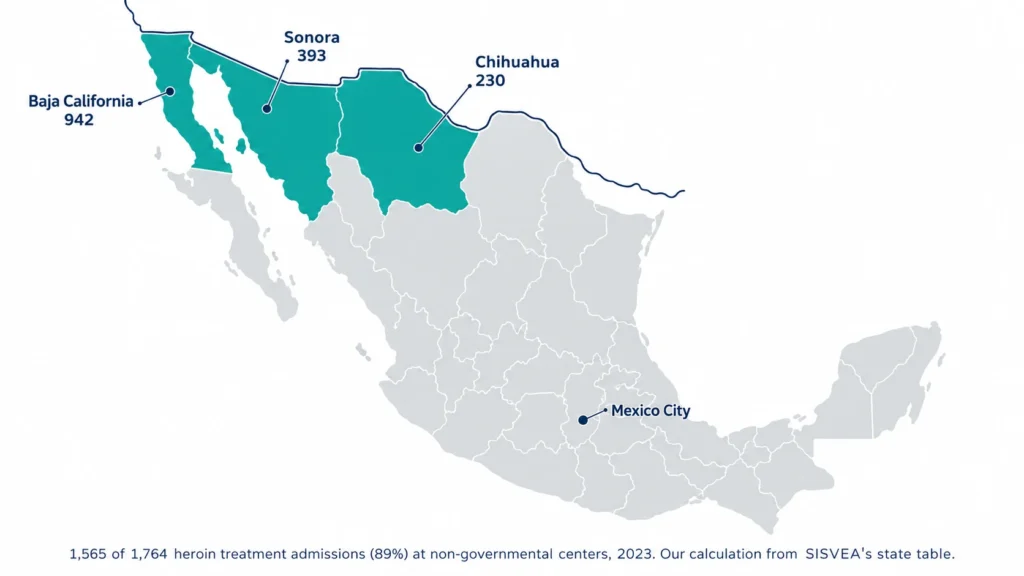
Mexico’s addiction surveillance system, SISVEA, logged 120,488 admissions in 2023 at 1,939 non-governmental treatment centers that offer stays of 30 to 180 days. Heroin was the main problem drug for 1,764 of them, or 1.5%, down from 3.1% in 2019. Methamphetamine accounted for 59.8%.
By our count of SISVEA’s state table, 1,565 of those 1,764 heroin admissions, or 89%, were in 3 border states: Baja California (942), Sonora (393) and Chihuahua (230). A 2016 national survey estimated that 23,251 people had used heroin in the past year. Researchers writing in The Lancet Regional Health Americas called that a likely gross underestimate.
Not everyone arrives by choice. Of the people entering these centers in 2023, 36.2% were brought by family or friends, and 7.6% said they were there against their will. Forced treatment is the pattern the Tijuana overdose study flagged. Mexico treats Americans too: 568 US residents sought care in these centers in 2023, up from 351 the year before, mostly in Baja California, Chihuahua and Sinaloa.
Medication has been hard to get. In 2021, Mexico had only 11 clinics offering methadone, according to the same Lancet Regional Health Americas researchers. In February 2023, the government shut the country’s only methadone manufacturing plant over quality concerns. Clinics in Tijuana, Mexicali and Ciudad Juárez turned away new patients, limited doses or stopped dosing. The plant stayed closed for nearly 7 months.
A 2026 study followed 200 methadone clinic patients in Tijuana over 3 periods of 6 months, starting in mid-2023. The share in methadone treatment fell from 36% to 13%, then rose to 26%. Street opioid use rose from 38% to 69% before falling again. The authors say the shortage may have contributed to these changes but couldn’t establish cause. They call for Mexico to authorize buprenorphine for opioid use disorder.
What’s sold as heroin often isn’t. In a 2020 Tijuana study, 55 of 59 samples sold as white powder heroin, or 93%, contained fentanyl, and the pure black tar samples didn’t. Fentanyl needs a longer washout before ibogaine than heroin does, so our screening asks what someone has been buying, in what form, and where.
Ibogaine And The Heroin Recovery Rate: What Studies In Mexico Found
2 of the main ibogaine outcome studies followed people treated at clinics in Mexico. Both found fast relief from withdrawal. Neither found most people off opioids months later.
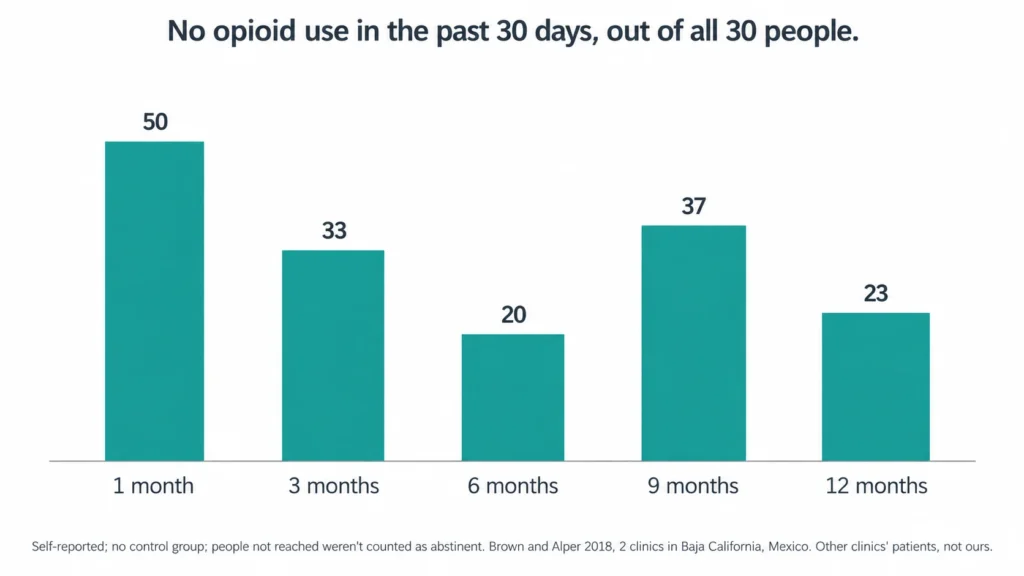
Brown and Alper followed 30 people with opioid dependence treated at 2 clinics in Baja California, 1 in Ensenada and 1 in Playas de Tijuana. Out of all 30, 50% reported no opioid use in the past 30 days at 1 month. Later shares were 33% at 3 months, 20% at 6, 37% at 9 and 23% at 12. Anyone the researchers couldn’t reach wasn’t counted as abstinent, and drug use was self-reported without lab tests.
Davis and colleagues surveyed 88 people treated at a clinic in Mexico between 2012 and 2015. 80% said ibogaine ended or sharply cut their withdrawal, 30% said they never used opioids again, and 41% reported more than 6 months off opioids when they answered.
Neither study had a control group, and the survey heard only from people who chose to answer. Ibogaine also carries cardiac risk. Brown and Alper note that it has been associated with deaths, most often from heart rhythm problems, though none of their 30 patients had a serious heart event. These studies describe other clinics’ patients, not ours. Read them as the range that’s been measured. Neither is a promise.
Heroin Recovery Studies By Treatment Type
Studies that kept people on methadone or buprenorphine found more of them alive and in treatment a year later. Detox-only studies, ibogaine included, found that most people weren’t reporting abstinence months later, and no placebo-controlled trial of ibogaine for opioid addiction has been published.
| Study | Who | Follow-up | What counted | Result | Limits |
| Smyth and colleagues, 2010, Ireland | 109 people after inpatient detox | Interview after discharge | Relapse: back to daily opiate use | 91% relapsed, 59% within 1 week | Only the 109 interviewed are counted |
| Hser and colleagues, 2001, California, US | 581 men in a court-ordered program, admitted 1962 to 1964 | 33 years | Urine test and interview | 284 died; of 242 interviewed, 55.8% tested negative for opiates and 20.7% positive for heroin | 24 lost to follow-up; 31 refused or couldn’t be interviewed |
| Strang and colleagues, 2003, London, UK | 137 people in a 28-day inpatient program | Up to 12 months | Deaths | All 3 overdose deaths came from the 37 who finished | 103 of 137 interviewed |
| Kakko and colleagues, 2003, Sweden, randomized | 40 adults with heroin addiction | 1 year | Still in treatment | Buprenorphine: 75%, no deaths. Taper then placebo: 0%, 4 deaths | Small trial |
| Sordo and colleagues, 2017, review pooling 19 cohort studies | People on methadone or buprenorphine | Varied | Deaths per 1,000 person-years | Methadone: 11.3 in treatment, 36.1 out. Buprenorphine: 4.3 in, 9.5 out | Observational, so other differences may explain part of the gap |
| Rafful and colleagues, 2018, Tijuana, Mexico | 671 people who inject drugs | 2011 to 2017 | Non-fatal overdose in the past 6 months | Recent involuntary treatment: 1.76 times the odds | Observational, so it can’t prove cause |
| Goldshear and colleagues, 2026, Tijuana, Mexico | 200 methadone clinic patients | 3 periods of 6 months from mid-2023 | Methadone treatment and street opioid use | Methadone treatment fell from 36% to 13%, then rose to 26%; opioid use rose from 38% to 69%, then fell | Observational; cause not established |
| Brown and Alper, 2018, 2 ibogaine clinics in Baja California, Mexico | 30 people with opioid dependence | 12 months | No opioid use in the past 30 days, self-reported | 50% at 1 month, 33% at 3, 20% at 6, 37% at 9 and 23% at 12 | No control group; unreached not counted as abstinent |
| Davis and colleagues, 2017, ibogaine clinic in Mexico | 88 people treated 2012 to 2015 | Up to about 3 years | Self-reported in an online survey | 30% never used opioids again; 41% off opioids for over 6 months | Only people who answered |
None of these studies can predict a single person’s odds. Together they show what moves the odds: staying in care, and getting through the first month alive.
What Our Clinic Publishes, And What It Doesn’t
We don’t publish a heroin recovery rate or a success rate. Nobody in this field can prove one to a standard we’d accept, so we don’t print one.
What we do publish is the protocol, the monitoring and the 90 days after. Our page on ibogaine treatment for heroin addiction grades the published evidence claim by claim. Withdrawal relief is the best-supported finding. For claims of a cure, it finds no evidence.
5 Questions To Ask About Any Clinic’s Recovery Rate
A recovery rate means little until you know who it counts, when it was measured and how. Ask these before you trust any clinic’s number.
- Who’s in the denominator: everyone who started, or only the people who finished and picked up the phone?
- How long after treatment was it measured? A 1-month figure and a 1-year figure make different claims.
- What counted as success: no use at all, less use, or “doing better”?
- Who checked, a urine test or the patient’s own report?
- What happened to the people the clinic lost track of, and were deaths counted?
Screening at our clinic is free, nothing is billed before it, and our itemized pricing lists what the 7 days and the 90 days of follow-up include.
If you’re comparing clinics in Mexico by their heroin recovery rate, ask what happens in the 4 weeks after treatment as well as on the dosing day. Start a screening with 3 questions, and a physician or nurse calls back within 1 business day.
Questions Families Ask About Heroin Recovery
What is the heroin recovery rate after rehab?
Relapse soon after treatment is common. In an Irish study, 91% of people leaving inpatient detox went back to daily opiate use, 59% within a week. Over 33 years, a US study in California found 55.8% of the surviving men it interviewed testing negative for opiates. But 48.9% of the original 581 had died.
Do methadone or buprenorphine improve heroin recovery?
They change who is alive and in treatment a year later. In a Swedish trial, 75% of people on a year of buprenorphine stayed in treatment, and none died. Everyone on a 6-day taper dropped out, and 4 of 20 died. A 2017 review pooling 19 cohort studies found death rates about 3 times higher out of methadone treatment than in it.
How long does it take to recover from heroin addiction?
Often years. In a 33-year US study in California, men who had been off heroin for at least 5 years were much less likely to relapse. Still, a quarter relapsed even after 15 years.
Why do people overdose after detox?
Detox lowers tolerance, so a person’s old dose can stop their breathing. A London study of 137 detox patients found all 3 overdose deaths of the next 4 months among the 37 who finished the program. In Tijuana, recent forced treatment came with 1.76 times the odds of a non-fatal overdose.
What is ibogaine’s success rate for heroin addiction?
No reliable figure exists, because no placebo-controlled trial has tested it. In a study of 30 people treated at 2 clinics in Baja California, 50% reported no opioid use in the past month at 1 month, and 23% did at 12 months. In a survey of 88 people treated in Mexico, 30% said they never used opioids again. Our clinic doesn’t publish a success rate.
What is the heroin recovery rate in Mexico?
We found no published national figure. Mexico’s surveillance system tracks who enters treatment and doesn’t follow outcomes. In 2023, heroin was the main problem drug for 1,764 people entering its reporting centers, and by our count 89% of them were in Baja California, Sonora and Chihuahua.
Sources
- Smyth BP, Barry J, Keenan E, Ducray K. Lapse and relapse following inpatient treatment of opiate dependence. Irish Medical Journal. 2010;103(6):176-179.
- McLellan AT, Lewis DC, O’Brien CP, Kleber HD. Drug dependence, a chronic medical illness: implications for treatment, insurance, and outcomes evaluation. JAMA. 2000;284(13):1689-1695.
- Hser YI, Hoffman V, Grella CE, Anglin MD. A 33-year follow-up of narcotics addicts. Archives of General Psychiatry. 2001;58:503-508. Summary: The consequences of long-term heroin addiction and the effects of treatment. Science and Practice Perspectives. 2002;1(1):56.
- Strang J, McCambridge J, Best D, Beswick T, Bearn J, Rees S, Gossop M. Loss of tolerance and overdose mortality after inpatient opiate detoxification: follow up study. BMJ. 2003;326(7396):959-960.
- Sordo L, Barrio G, Bravo MJ, Indave BI, Degenhardt L, Wiessing L, Ferri M, Pastor-Barriuso R. Mortality risk during and after opioid substitution treatment: systematic review and meta-analysis of cohort studies. BMJ. 2017;357:j1550.
- Kakko J, Svanborg KD, Kreek MJ, Heilig M. 1-year retention and social function after buprenorphine-assisted relapse prevention treatment for heroin dependence in Sweden: a randomised, placebo-controlled trial. Lancet. 2003;361(9358):662-668.
- Rafful C, Orozco R, Rangel G, Davidson P, Werb D, Beletsky L, Strathdee SA. Increased non-fatal overdose risk associated with involuntary drug treatment in a longitudinal study with people who inject drugs. Addiction. 2018;113(6):1056-1063.
- Goldshear JL, Harvey-Vera A, Rangel G, Abramovitz D, and colleagues. Methadone treatment and associated health and social outcomes after a national manufacturing closure in Mexico: a longitudinal observational cohort study in Tijuana. The Lancet Regional Health Americas. 2026;62:101577.
- Strathdee SA, Goodman-Meza D, Rafful CM. Addressing opioid use disorder: Mexico’s step backwards. The Lancet Regional Health Americas. 2023;100520.
- Fleiz C and colleagues. Fentanyl is used in Mexico’s northern border: current challenges for drug health policies. Wiley-Blackwell, 2020. Record held by the Instituto Nacional de Psiquiatría Ramón de la Fuente Muñiz.
- Secretaría de Salud, Dirección General de Epidemiología. Sistema de Vigilancia Epidemiológica de las Adicciones (SISVEA): Informe 2023. September 2024.
- Brown TK, Alper K. Treatment of opioid use disorder with ibogaine: detoxification and drug use outcomes. American Journal of Drug and Alcohol Abuse. 2018;44(1):24-36.
- Davis AK, Barsuglia JP, Windham-Herman AM, Lynch M, Polanco M. Subjective effectiveness of ibogaine treatment for problematic opioid consumption: short- and long-term outcomes and current psychological functioning. Journal of Psychedelic Studies. 2017;1(2):65-73.
- Esperança MP, Gomes NGM, Campos MG. Ibogaine: therapeutic potential, cardiac safety, and translational perspectives in the treatment of substance use disorders, a scoping review. Molecules. 2026;31(3):545.
This article is information, not medical advice. Ibogaine is not approved by the FDA and carries cardiac risk. Whether it is an option for you is decided by a physician after an EKG and blood tests, never by an article. If you or someone else is in danger now, call your local emergency number.