People who search “what is methamphetamine addiction recovery rate” usually want 1 number. A recovery rate is the share of people who stop using meth and stay stopped for a set time, and Mexico doesn’t publish one. In a long-term California study, 61% of people treated for meth used it again within a year, with 1 use counted as relapse.
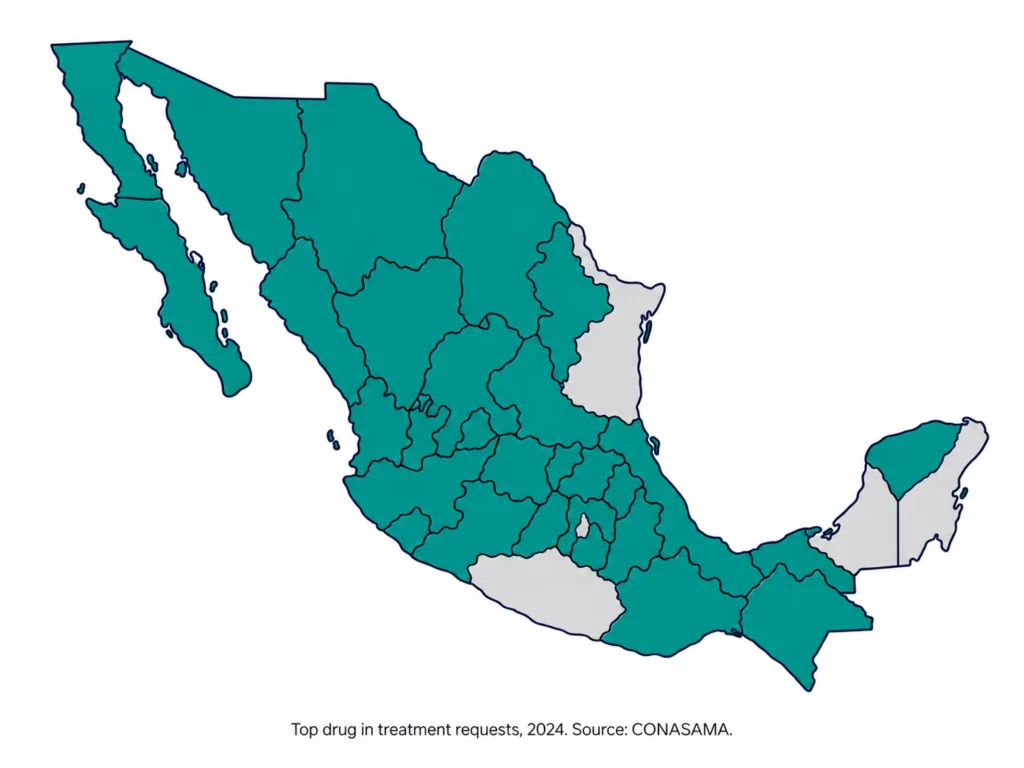
Mexico’s official reports count people who ask for treatment and don’t report who recovers. The share of those requests tied to stimulants like meth keeps growing. In 2024, 172,380 people sought addiction treatment in the national network, and amphetamine-type stimulants, the group that includes crystal meth, were the top drug in 27 of Mexico’s 32 federal entities (its states plus Mexico City).
What Does A Meth Recovery Rate Measure?
It measures whatever its 3 rules say: what counts as recovery, how long people are followed, and who stays in the count. These 5 studies used different rules, so their numbers don’t line up.
| Study | Who was followed | What counted | What they found |
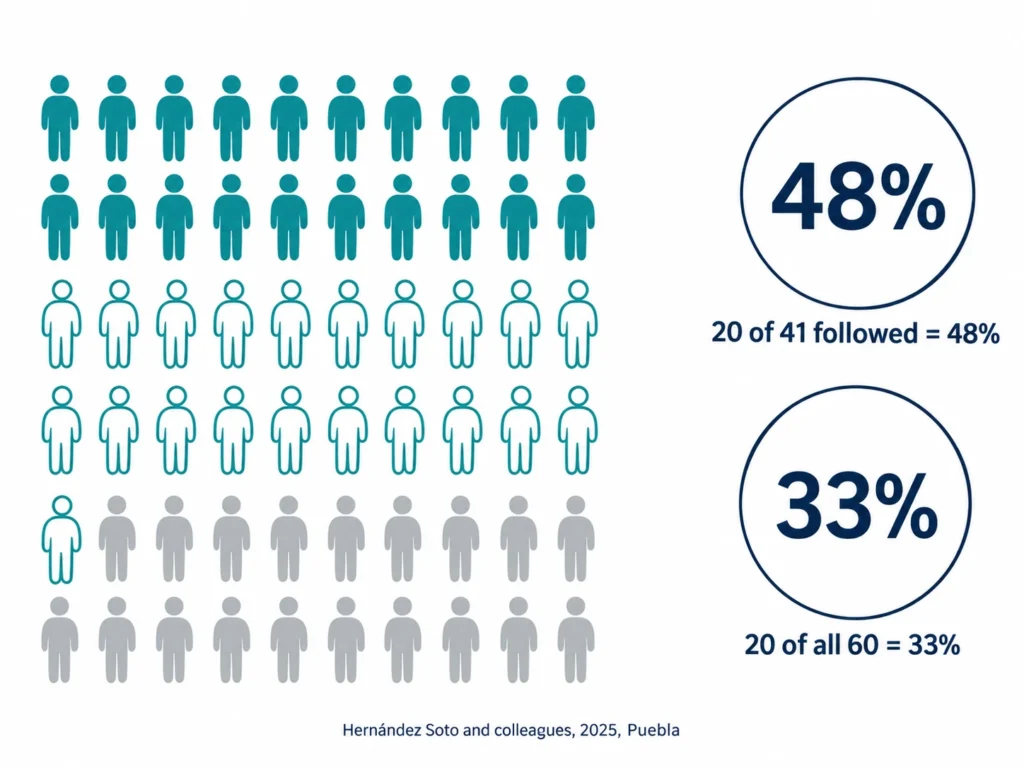
| Hernández Soto and colleagues, 2025 | 60 people in a 35-day residential meth program at Puebla’s State Mental Health Center, 2022 to 2023 | Finishing the program, then being off meth at 3 months | 50% finished. 20 of the 41 who came back for follow-up were off meth at 3 months |
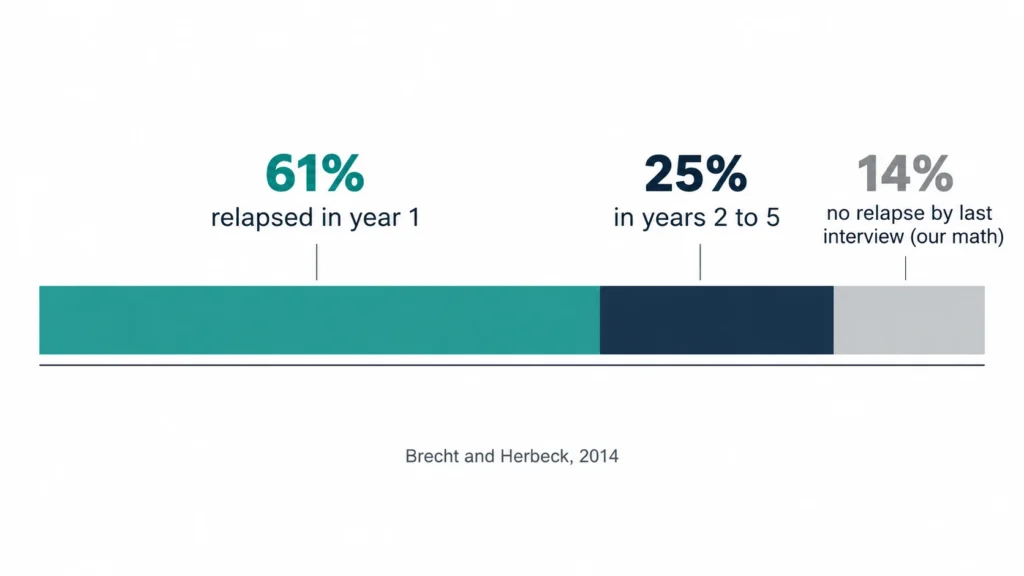
| Brecht and Herbeck, 2014 | People leaving meth treatment in California, most admitted in 1996, followed about 5 years | No meth use at all. 1 use was a relapse | 61% relapsed within 1 year. Another 25% relapsed in years 2 to 5 |
| McKetin and colleagues, 2012 (MATES) | 248 people in residential rehab, 112 in detox and 101 not in treatment, in Sydney and Brisbane | Staying off meth the whole time | Rehab added 33 people per 100 who stayed off meth at 3 months, 14 at 1 year and 6 at 3 years. Detox alone didn’t cut use |
| McLellan and colleagues, 2000 | Treatment studies for alcohol and all drugs | Going back to active use after treatment | 40% to 60% relapsed |
| Kelly and colleagues, 2017 and 2019 | A national survey of US adults | Used to have a drug or alcohol problem and no longer does | 9.1% of adults, about 22.35 million. Meth was the main drug for 7%. The typical person made 2 serious tries |
The Puebla row shows how much the count matters. The study reports that 48% of the 41 people who came to follow-up were off meth at 3 months (20 of 41 works out to 48.8%). Counted against all 60 who started, the same 20 people are 33%. Same patients, same 3 months, 2 recovery rates.
Methamphetamine addiction recovery rate in Mexico: what the 2026 data show
Mexico has no national recovery rate for meth. Its data show that more adults are trying stimulants like meth and that a growing share of treatment requests involve them. However, these numbers don’t show how many people recover from it.
| Measure | Number | Source |
| People aged 12 to 65 who have ever used amphetamine-type stimulants | 1.5% in 2025 (1,375,344 people), up from 0.9% in 2016 | ENCODAT 2025 |
| Men who have ever used them | 2.5% in 2025, up from 1.4% | ENCODAT 2025 |
| Used them in the past year | 0.3% in 2025 (247,467 people) | ENCODAT 2025 |
| Average age at first use | 22.1 in 2025, up from 18.9 | ENCODAT 2025 |
| People who sought addiction treatment in 2024 | 172,380 | CONASAMA, 2025 |
| Treatment requests handled outside government centers | 69.3% (18.0% in public CECOSAMA centers, 12.7% in CIJ) | CONASAMA, 2025 |
| Federal entities where these stimulants were the top drug in treatment | 27 of 32 in 2024, up from 25 in 2023 | CONASAMA, 2025 |
| Treatment requests naming these stimulants as the main drug | 9.5% in 2013, 49.1% in 2023, 51.0% in 2024 | CONASAMA |
The national survey, ENCODAT 2025, shows who’s using. CONASAMA’s 2025 fact sheet shows who’s struggling. Neither shows who recovers.
Where people in Mexico get treatment for meth
Mostly outside government clinics. In 2024, 69.3% of treatment requests went to non-governmental centers. In Aguascalientes, researchers found that most people seeking help for crystal go to civil-society residential centers known as anexos, and crystal accounted for 66.7% of residential admissions in state surveillance data.
Some of those centers hold people against their will. In a Tijuana study of 671 people who inject drugs, followed from 2011 to 2017, 15.4% reported recent involuntary treatment. It was linked to 1.76 times the odds of a non-fatal overdose. It’s an observational study, so it shows a link rather than proof of cause. Forced treatment doesn’t show up in the data as recovery. It shows up as a risk. Every patient at our clinic comes by choice, after a physician’s written yes.
The 1 public program outcome we found comes from a 2025 Puebla study. Half of 60 patients finished the 35-day program. Of those who didn’t, 53% left because a relative asked for their discharge, and 36.8% were expelled. Families decide more of these stays than most people realize. It’s a small review of 1 center’s records, so its numbers describe that program only.
How the recovery rate changes over time
It drops fastest in the first year, then slows. In the California study, 61% relapsed in year 1 and another 25% in years 2 to 5. That leaves about 14% who hadn’t relapsed by their last interview (our math from their figures). Those patients mostly entered treatment in 1996, and today’s drug supply is different.
Rehab’s head start fades too. In the Australian MATES study, residential rehab added 33 people per 100 who stayed off meth at 3 months, 14 at 1 year and 6 at 3 years.
A relapse isn’t the end of the count. In a US national study, 2,002 adults who had resolved a drug or alcohol problem made a median of 2 serious attempts first, and the number didn’t differ by main drug. Plan for the first year, and plan for a second try.
A relapse can also be dangerous. In an emergency in Mexico, call 911. For guidance at any hour, Mexico’s Línea de la Vida is 800 911 2000. In the US, call or text 988 in a crisis.
Why do meth recovery rates vary so much?
Each number counts something different, over a different stretch of time, with different people left out. 7 of the 11 figures we checked online trace back to 3 studies. We couldn’t find any study behind the other 4.
| The number you’ll see | Where it comes from | What it measures |
| “61% relapse within a year” | Brecht and Herbeck, 2014 | Any meth use in the year after treatment, California, 1990s |
| “39% stay clean for a year” | The same study, read the other way | No meth uses at all in that first year |
| “48% abstinent at 3 months” and “12% at 3 years” | News coverage of MATES, 2012 | Residential rehab clients only |
| “15% without help” and “5% after 3 years without treatment” | Same coverage | Detox-only and no-treatment groups together |
| “40% to 60% relapse” | McLellan and colleagues, 2000 | Alcohol and all drugs, not meth |
| “37% average recovery rate” and “16% to 20% national rate” | No study we could find | Unknown |
| “88% or 92% relapse at least once” | No study we could find | Unknown |
Watch the denominator most of all. Some studies count people they can’t reach as still using. Others drop them, which pushes the rate up, because people who are using tend to be harder to reach. The Puebla figures show the swing: 48% or 33% from the same group.
Does treatment raise the methamphetamine addiction recovery rate?
Yes, though the effect of a single stay faded. The best-supported treatment is a routine of urine tests and small rewards.
Contingency management gives people small rewards, such as gift cards, when their urine tests come back negative. The 2024 guideline from the American Society of Addiction Medicine and the American Academy of Addiction Psychiatry backs it more strongly than any other stimulant treatment. It pairs it with cognitive behavioral therapy, a talk therapy that targets the thoughts and habits around use.
In a 2025 study of US veterans’ health records, 1,481 people with stimulant use disorder who got contingency management were 41% less likely to die within a year than 1,481 matched people who didn’t. It’s a record study, so it shows a link. A randomized trial would be needed to prove the cause.
No medicine is FDA-approved for meth addiction. In the largest trial, 13.6% of people on injectable naltrexone plus bupropion reached the 12-week goal, against 2.5% on placebo. Detox on its own didn’t reduce meth use in the Australian study.
Most of this evidence comes from the US and Australia. In Mexico, ask any program which of these it offers and which of its staff are physicians. The Puebla program, for example, pairs detox with a 12-step-based approach called the Minnesota Model. Our medical team page explains who is in the room.
How to judge a recovery rate a clinic quotes you
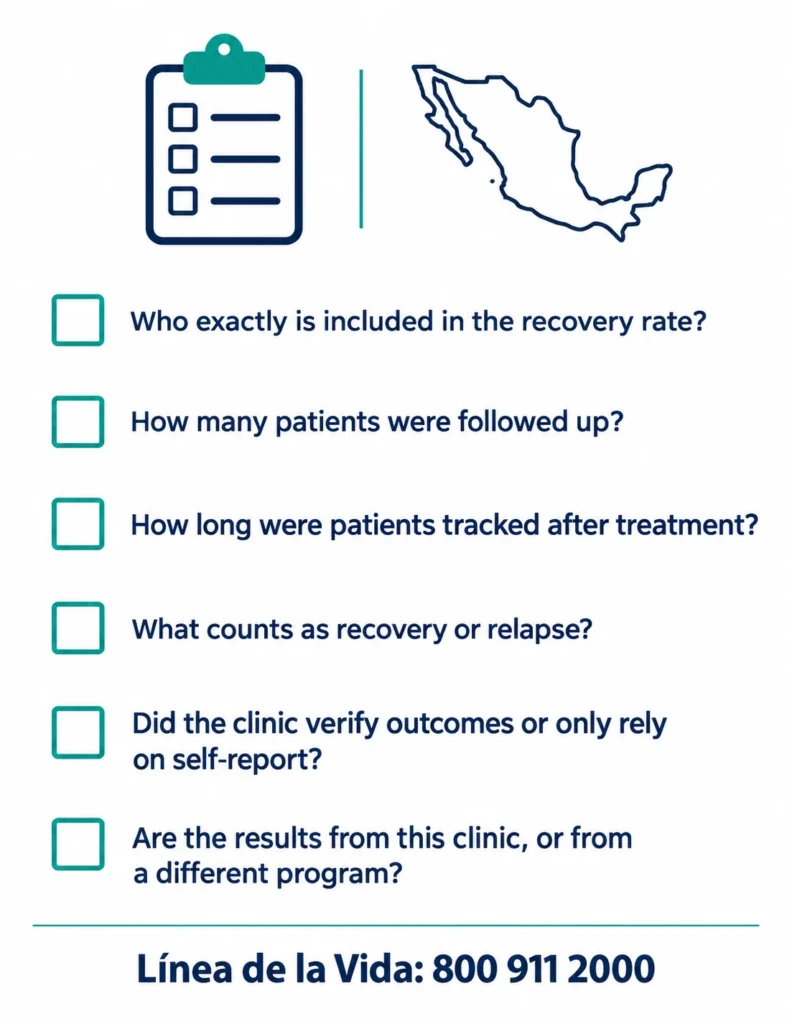
Ask what counted, for how long, and who was left out. In Mexico, also check who runs the place.
1. What counted as recovery: no use at all, or no use in the past 30 days?
2. Over how long: 3 months, 1 year or 5 years?
3. Out of whom: everyone who started, or only the people who came back?
4. Was it checked with urine tests, or based on what people said?
5. Is the center in CONASAMA’s national directory of recognized residential centers? Recognized centers are checked against the NOM-028-SSA2-2009 standard and for respect of human rights.
6. Will the person be there by choice? Forced treatment was linked to more overdoses in Tijuana.
If a center uses force, locks people in or denies medical care, report it to your state’s addiction commission. Línea de la Vida (800 911 2000) can help you find another option.
Why we don’t quote a meth recovery rate yet
Our numbers for meth are still too small to publish as a rate, and the evidence for ibogaine in meth is thin. So we share raw counts with the denominator.
Ibogaine isn’t a proven treatment for meth addiction. No published study has given it to a group of people dependent on meth and reported outcomes. It also carries heart risks. It has been linked to deaths from dangerous heart rhythms, and in a 2022 Dutch safety study of 14 people dependent on opioids, the QTc, an EKG measure that signals rhythm risk when it runs long, rose by an average of 95 ms at its peak. 6 of the 14 still had a QTc above 450 ms more than 24 hours after a single dose. Our page on ibogaine for meth explains the evidence and why our heart screen is stricter for meth than for opioids. Our post on how ibogaine affects the brain covers what is and isn’t known about how it works.
Anything medical goes to our psychiatrist the same day. The calls are part of the itemized price, not an add-on.
The answer to “what is methamphetamine addiction recovery rate” depends on who did the counting. In Mexico, ask the 6 questions above before you trust a number, and look for contingency management or a structured program with follow-up. If you want to know whether ibogaine is an option for someone you love, start a screening with their medical records. A physician reviews them before any money changes hands, and the answer can be no.
Questions families ask about meth recovery
What is methamphetamine addiction recovery rate in Mexico?
Mexico doesn’t publish a national rate. Its official reports count treatment requests instead: 172,380 in 2024. The only recent outcome study we found comes from a public program in Puebla. It recorded 20 of 60 patients off meth at 3 months, or 20 of the 41 who came back for follow-up.
What is methamphetamine addiction recovery rate after 1 year?
It depends on the rule. In a California study of people treated for meth, 61% used it again within a year, and 1 use counted as relapse. So 39% had no meth use at all that year. A looser rule, like no use in the past 30 days, gives a higher number from the same people.
Does rehab improve the recovery rate for meth?
Yes, but the boost fades. In an Australian study, residential rehab added 33 people per 100 who stayed off meth at 3 months, 14 at 1 year and 6 at 3 years. Detox alone made no difference. Contingency management, which gives small rewards for negative urine tests, has the strongest backing in the 2024 addiction medicine guideline.
Is relapse normal in meth recovery?
Yes. In a US national study of adults who had resolved a drug or alcohol problem, the typical person made 2 serious attempts first. That didn’t differ by main drug. In Mexico, call 911 in an emergency, or Línea de la Vida at 800 911 2000 for guidance at any hour.
How can I check a meth rehab center in Mexico?
Look for it in CONASAMA’s national directory of recognized residential centers. Those centers are checked against the NOM-028-SSA2-2009 standard and for respect of human rights. Avoid any center that forces people in: in a Tijuana study, forced treatment was linked to 1.76 times the odds of a non-fatal overdose.
Does ibogaine work for meth addiction?
Nobody knows yet, and it isn’t a proven treatment. No published study has given ibogaine to a group of people dependent on meth and reported outcomes; the closest data come from a cocaine study and animal research. Ibogaine can also cause dangerous changes in heart rhythm, and we screen the heart more strictly for meth than for opioids. Our page on cocaine addiction covers the other stimulant we treat, and our post on what else ibogaine treats covers the rest.
Sources
• Comisión Nacional de Salud Mental y Adicciones (CONASAMA). Hoja de datos: Demanda de tratamiento por consumo de sustancias psicoactivas en México, 2025. June 27, 2025.
• Instituto Nacional de Salud Pública, CONASAMA and partners. Encuesta Nacional de Consumo de Drogas, Alcohol y Tabaco (ENCODAT) 2025: executive summary and full report. December 2025.
• Hernández Soto JL, Ramírez Dueñas LK, Lara Benítez EA, Sánchez Ramos DL. Cumplimiento del programa de rehabilitación en pacientes dependientes de “cristal” del Centro Estatal de Salud Mental. Ciencia Latina Revista Científica Multidisciplinar. 2025;9(3). doi:10.37811/cl_rcm.v9i3.17625.
• Rafful C, Orozco R, Rangel G, Davidson P, Werb D, Beletsky L, Strathdee SA. Increased non-fatal overdose risk associated with involuntary drug treatment in a longitudinal study with people who inject drugs. Addiction. 2018;113(6):1056-1063.
• Martínez Martínez KI, et al. Rompiendo el cristal: percepciones de los usuarios de metanfetamina sobre los desafíos para acceder y permanecer en un tratamiento. Universidad Autónoma de Aguascalientes. 2024.
• Brecht ML, Herbeck D. Time to relapse following treatment for methamphetamine use: a long-term perspective on patterns and predictors. Drug and Alcohol Dependence. 2014;139:18-25.
• McKetin R, Najman JM, Baker AL, et al. Evaluating the impact of community-based treatment options on methamphetamine use: findings from the Methamphetamine Treatment Evaluation Study (MATES). Addiction. 2012;107(11):1998-2008.
• McLellan AT, Lewis DC, O’Brien CP, Kleber HD. Drug dependence, a chronic medical illness: implications for treatment, insurance, and outcomes evaluation. JAMA. 2000;284(13):1689-1695.
• Kelly JF, et al. Prevalence and pathways of recovery from drug and alcohol problems in the United States population. Drug and Alcohol Dependence. 2017;181:162-169. Primary-drug shares from the Recovery Research Institute, Letter from the Director, December 15, 2017.
• Kelly JF, Greene MC, Bergman BG, White WL, Hoeppner BB. How many recovery attempts does it take to successfully resolve an alcohol or drug problem? Alcoholism: Clinical and Experimental Research. 2019;43(7):1533-1544.
• Coughlin LN, et al. Contingency management for stimulant use disorder and association with mortality: a cohort study. American Journal of Psychiatry. 2025;182(11):1016-1023.
• American Society of Addiction Medicine and American Academy of Addiction Psychiatry. Clinical practice guideline on the management of stimulant use disorder. Journal of Addiction Medicine. 2024;18(1S Suppl 1):1-56.
• Trivedi MH, Walker R, Ling W, et al. Bupropion and naltrexone in methamphetamine use disorder. New England Journal of Medicine. 2021;384(2):140-153.
• Knuijver T, Schellekens A, Belgers M, Donders R, van Oosteren T, Kramers K, Verkes R. Safety of ibogaine administration in detoxification of opioid-dependent individuals: a descriptive open-label observational study. Addiction. 2022;117(1):118-128.
This article is information, not medical advice. Ibogaine is not approved by the FDA and carries cardiac risk. Whether it is an option for you is decided by a physician after an EKG and blood tests, never by an article. If you or someone else is in danger now, call your local emergency number.