
Opioid addiction vs dependence comes down to control. Dependence means the body has adapted to opioids, so stopping brings withdrawal. Addiction means use has slipped out of a person’s control and keeps going despite harm. Someone can have either one without the other.
The difference decides what kind of help is safe. Treat a stable patient’s dependence like addiction and you can push them into withdrawal, pain or worse. Treat real addiction like “only dependence” and a short detox leaves the dangerous part untouched.
What Is The Difference Between Opioid Addiction And Dependence?
Opioid dependence is a physical adaptation: after repeated doses, the body needs opioids to avoid withdrawal. Opioid addiction is a medical condition, diagnosed as moderate or severe opioid use disorder (OUD), in which craving and lost control drive use despite harm. Under DSM-5, tolerance and withdrawal don’t count toward OUD when opioids are taken as prescribed under medical supervision.
| Opioid dependence | Opioid addiction (moderate or severe OUD) | |
| What it is | The body’s adjustment to repeated opioid doses | Lost control over opioid use despite harm |
| Main signs | Tolerance, plus withdrawal when doses drop or stop | Craving, failed attempts to cut back, use that crowds out work, family and safety |
| Who develops it | Most people who take opioids daily for a stretch, including patients who follow their prescription exactly | A smaller group; supervised, as-prescribed use on its own never meets the diagnosis |
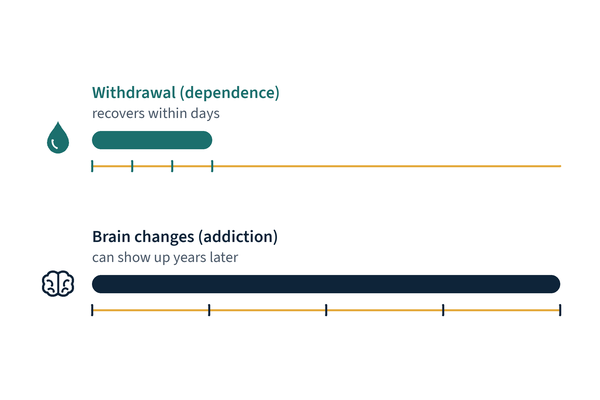
| How long it lasts | Acute withdrawal changes recover within days; a slow taper keeps them manageable | Brain changes can show up years after withdrawal has ended |
| Counts toward an OUD diagnosis? | Not for supervised, as-prescribed use; yes for non-prescribed use | It is the diagnosis |
| What helps | A slow, supervised taper, or staying on a medicine that works | Medications for OUD, counseling and long-term follow-up |
What opioid dependence looks like
Take an opioid every day and the nervous system adjusts to it. The same dose starts doing less, which is tolerance, and stopping suddenly brings withdrawal: sweating, yawning, a runny nose, diarrhea, aching muscles, goosebumps and restlessness. Researchers at the National Institute on Drug Abuse note that physical dependence develops quickly and shows up in most people who take repeated doses.
None of that requires misuse. A hospice patient on morphine, a worker on long-term pain treatment and someone stable on methadone can all be physically dependent while doing exactly what their doctor asked.
What opioid addiction looks like
Addiction shows up in behavior. The person takes more than planned and can’t cut back. They spend hours getting and recovering from opioids, and they keep going after it costs them a job, a relationship or their health. Those patterns trace back to changes in the brain’s reward system, which is what makes opioids so addictive in the first place.
In 2013, DSM-5 replaced the old “opioid abuse” and “opioid dependence” diagnoses with one label: opioid use disorder, graded mild, moderate or severe. Moderate and severe OUD line up with what most people mean by addiction.
How Doctors Tell Them Apart Using DSM-5
Doctors diagnose opioid use disorder when someone meets at least 2 of 11 DSM-5 criteria within 12 months. CDC’s diagnosis guidance for clinicians spells out the rule that matters most here: the last 2 criteria, tolerance and withdrawal, don’t count for people taking opioids only under appropriate medical supervision.
The 11 criteria fall into 4 groups. Most of them describe behavior, and only the last group is physical:
- Lost control: taking more or for longer than intended, wanting or failing to cut down, spending a lot of time getting or recovering from opioids, and craving.
- Life problems: falling behind at work, school or home; using despite fights with family or friends; giving up activities that used to matter.
- Risky use: using in physically dangerous situations, or continuing despite a health problem opioids make worse.
- Physical signs: tolerance and withdrawal.
Meeting 2 or 3 criteria means mild OUD, 4 or 5 means moderate, and 6 or more means severe. Those same thresholds decide which billing code lands on a chart.
The exception for prescribed use
Consider a patient who takes oxycodone exactly as her surgeon prescribed and develops tolerance and withdrawal. Those 2 physical changes don’t count toward a diagnosis for her. If nothing else on the list applies, her body is dependent and she doesn’t have opioid use disorder.
Where the exception stops
The exception covers supervised medical use only. For someone buying pills or powder, tolerance and withdrawal do count, and NIDA researchers point out that those 2 alone can reach the 2-criterion minimum for mild OUD. A person using street fentanyl every day can’t be “only dependent” under the manual’s own rules.
The rule for buprenorphine and methadone
DSM-5 has a specifier, “on maintenance therapy,” for people taking methadone or buprenorphine who meet no criteria for that medicine except tolerance or withdrawal. A stable patient’s daily dose isn’t held against them, which fits what the medicine is for.
Can You Be Dependent On Opioids Without Being Addicted?
Yes. Pain patients on long-term prescriptions and people stable on methadone or buprenorphine are 2 common examples.
Medical charts blur the line more than most families expect. VA researchers reviewed the records of 520 veterans whose charts carried a code for opioid use, abuse or dependence. About 58% showed a high likelihood of opioid use disorder, and nearly 20% were taking prescribed opioids with no sign of misuse.
A wrong addiction label follows people. A 2021 Annals of Medicine commentary by Maia Szalavitz and colleagues lays out where it leads: stigma, lost access to medicines patients need and extra scrutiny for patients and their doctors.
Why Mixing Them Up Can Be Dangerous
People get hurt in both directions. Forcing a stable patient off opioids can set off a crisis, and calling real addiction “only dependence” can delay treatment that keeps people alive.
Stopping a medicine that’s working
The CDC’s 2022 opioid guideline warns about rapid tapers and abrupt stops made without the patient’s input. It links them to serious withdrawal, worse pain, psychological distress, overdose and suicidal thoughts. It calls for slow tapers built with the patient and backed by support.
Leaving buprenorphine or methadone too soon
A 2017 meta-analysis in The BMJ found that people on buprenorphine died at a rate of about 4.5 per 1,000 person-years while in treatment. In the first 4 weeks after leaving, that rate jumped to 32 before settling near 11. Methadone showed the same spike in the month after people stopped.
That’s why we don’t accept stable Suboxone patients who have no medical reason to come off. Physical dependence on a medicine that’s working isn’t, by itself, a reason to stop it.
Calling addiction “only dependence”
The opposite mistake costs time. A detox clears the physical dependence and leaves the addiction in place, and tolerance falls once opioids stop. Going back to an old dose after that drop can be deadly.

Why A Medical Record May Say “Opioid Dependence”
On a US medical record, “opioid dependence” is usually the billing label for moderate or severe opioid use disorder, the condition most people call addiction. It doesn’t describe the narrow physical dependence a pain patient can have.
DSM-5 retired “dependence” as a diagnosis in 2013, but the code set US insurers use kept the word. Under ICD-10-CM, mild OUD is coded F11.10, titled “opioid abuse,” and moderate or severe OUD is coded F11.20, titled “opioid dependence.”
| Code on the record | Official title | What it usually means |
| F11.10 | Opioid abuse, uncomplicated | Mild OUD, 2 to 3 criteria |
| F11.20 | Opioid dependence, uncomplicated | Moderate or severe OUD, 4 or more criteria |
| F11.21 | Opioid dependence, in remission | Moderate or severe OUD, now in remission |
| 6C43.2 (ICD-11) | Opioid dependence | The World Health Organization’s name for the same diagnosis |
WHO’s ICD-11, in use since January 2022, files the diagnosis as “opioid dependence” too. If you’re sending records for a screening, treat the code as a question for the doctor who wrote it, and read the notes for what’s behind it.
What The Difference Means For Ibogaine Screening
Ibogaine is being studied for opioid use disorder, and its clearest documented effect is on withdrawal, the dependence half. The addiction half is what the 90 days of follow-up after treatment are for.
In an observational study of 30 people treated at ibogaine clinics in Mexico, Brown and Alper reported that ibogaine was associated with substantive effects on withdrawal. Half the group reported no opioid use in the 30 days before their 1-month follow-up, and drug use scores improved most at that 1-month mark. With 30 patients and no control group, it’s an early signal that still needs controlled trials.
The difference sorts the people who contact us into 4 groups. Each one gets a different answer:
| Physically dependent | Not physically dependent | |
| Addicted (moderate or severe OUD) | Daily fentanyl, heroin or pill use. Screening can go ahead, but the dependence gets handled first, because opioids still in the body make ibogaine dosing more dangerous. | Less common with opioids; typical of cocaine or meth, where ibogaine’s withdrawal effect doesn’t apply. |
| Not addicted | Stable on buprenorphine or methadone. Not an ibogaine case: staying on a medicine that works is the safer path. | Occasional or past use. Not a candidate. |
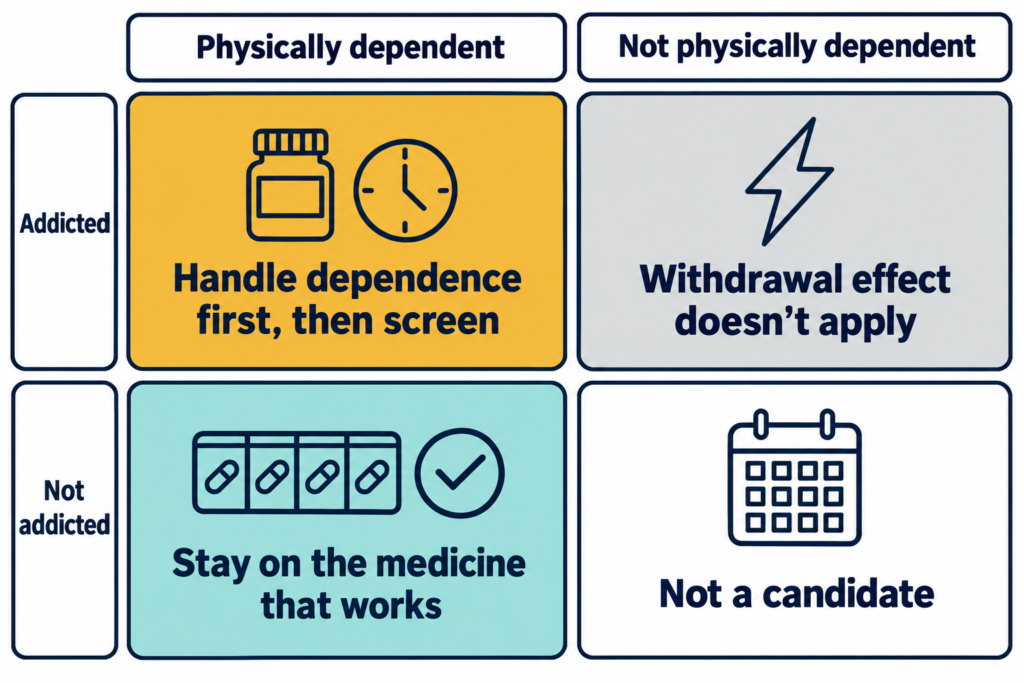
Handling the dependence first can mean a planned fentanyl washout or a switch off methadone, and that planning is often why a screening comes back “not yet.” We’d rather lose a booking than take a stable patient off a medicine that’s keeping them alive. That’s the logic behind every screening for our opioid addiction treatment.
Signs It’s Moving Past Dependence
Look at behavior first. Withdrawal only shows the body has adapted, while these signs point to control slipping:
- Running out of a prescription early, or asking for refills ahead of schedule
- Getting opioids from other people, other doctors or the street
- Taking pills for sleep, stress or boredom instead of pain
- Trying to cut back and failing, more than once
- Hiding use, lying about amounts, or missing work and family plans because of it
- Strong cravings, even on days without pain
If any of these show up, ask a doctor for a full assessment against the 11 DSM-5 criteria. Don’t stop or cut a prescribed opioid on your own while you wait.
Frequently Asked Questions About Opioid Addiction Vs Dependence
Is opioid dependence the same as opioid addiction?
No. Opioid dependence is the body’s adaptation to regular opioid use, shown by tolerance and withdrawal. Opioid addiction is moderate or severe opioid use disorder, marked by craving and lost control. DSM-5 doesn’t count tolerance or withdrawal toward a diagnosis when opioids are taken as prescribed under medical supervision.
Can you be dependent on opioids without being addicted?
Yes. Most people who take opioids daily for a stretch become physically dependent, including patients who follow their prescription exactly. In a VA review of 520 veterans with opioid codes on their charts, nearly 20% were taking prescribed opioids with no sign of misuse.
Does opioid withdrawal mean I’m addicted?
Not by itself. Withdrawal shows physical dependence, and for prescribed, supervised use it doesn’t count toward an opioid use disorder diagnosis at all. For non-prescribed use, tolerance plus withdrawal can already meet the 2-criterion minimum for mild OUD.
Is someone on Suboxone or methadone still addicted?
No, as long as they meet no other criteria. DSM-5’s “on maintenance therapy” specifier covers people on methadone or buprenorphine whose only signs are tolerance or withdrawal to that medicine. Staying on treatment also protects lives: a 2017 BMJ meta-analysis found that buprenorphine patients’ death rate jumped from about 4.5 to 32 per 1,000 person-years in the first 4 weeks after they stopped.
What does F11.20 mean on a medical record?
F11.20 is the ICD-10-CM code titled “opioid dependence, uncomplicated,” and it’s used for moderate or severe opioid use disorder. The title says dependence, but the code describes addiction rather than the physical dependence a pain patient can have. Mild OUD is coded F11.10.
How long does opioid dependence last after stopping?
The acute withdrawal changes recover within days, according to researchers at the National Institute on Drug Abuse, and a slow taper keeps symptoms manageable. Addiction runs on a longer clock: brain changes linked to it can show up years after withdrawal ends.
Can ibogaine treat opioid dependence or addiction?
Ibogaine’s clearest documented effect is on opioid withdrawal; in a 30-person observational study, half the patients reported no opioid use at their 1-month follow-up. It isn’t FDA-approved, it can dangerously lengthen the heart’s QT interval, and it doesn’t replace long-term follow-up for the addiction itself.
Get The Records Read Before Anyone Changes A Dose
If someone is in danger right now, call 911 or SAMHSA’s free, confidential National Helpline at 1-800-662-4357. This article is general information and isn’t medical advice, so don’t stop or change an opioid or a treatment medicine without the prescriber.
When it’s your son, your mother or you, opioid addiction vs dependence is a practical question with risk on both sides. Send us the records before anyone changes a dose, and our medical team will go through the codes, prescriptions and history with you. You’ll get a written yes, not yet or no, with the reason behind it.
References
- American Psychiatric Association. Diagnostic and Statistical Manual of Mental Disorders. 5th ed. American Psychiatric Association; 2013.
- Volkow ND, Blanco C. Medications for opioid use disorders: clinical and pharmacological considerations. J Clin Invest. 2020;130(1):10-13. doi:10.1172/JCI134708
- Centers for Disease Control and Prevention. Applying CDC’s Guideline for Prescribing Opioids: opioid use disorder training module. cdc.gov
- Lagisetty P, Garpestad C, Larkin A, et al. Identifying individuals with opioid use disorder: validity of International Classification of Diseases diagnostic codes for opioid use, dependence and abuse. Drug Alcohol Depend. 2021;221:108583. doi:10.1016/j.drugalcdep.2021.108583
- Szalavitz M, Rigg KK, Wakeman SE. Drug dependence is not addiction-and it matters. Ann Med. 2021;53(1):1989-1992. doi:10.1080/07853890.2021.1995623
- Dowell D, Ragan KR, Jones CM, Baldwin GT, Chou R. CDC clinical practice guideline for prescribing opioids for pain, United States, 2022. MMWR Recomm Rep. 2022;71(3):1-95. cdc.gov/mmwr
- Sordo L, Barrio G, Bravo MJ, et al. Mortality risk during and after opioid substitution treatment: systematic review and meta-analysis of cohort studies. BMJ. 2017;357:j1550. doi:10.1136/bmj.j1550
- American Psychiatric Association. DSM-5 diagnoses and new ICD-10-CM codes. October 2017. psychiatry.org
- Centers for Medicare & Medicaid Services. ICD-10-CM code set, category F11: opioid related disorders. cms.gov
- World Health Organization. International Classification of Diseases, 11th Revision (ICD-11): 6C43.2 Opioid dependence.
- Brown TK, Alper K. Treatment of opioid use disorder with ibogaine: detoxification and drug use outcomes. Am J Drug Alcohol Abuse. 2018;44(1):24-36. doi:10.1080/00952990.2017.1320802
- Knuijver T, Schellekens A, Belgers M, et al. Safety of ibogaine administration in detoxification of opioid-dependent individuals. Addiction. 2022. PMC9292417
This article is information, not medical advice. Ibogaine is not approved by the FDA and carries cardiac risk. Whether it is an option for you is decided by a physician after an EKG and blood tests, never by an article. If you or someone else is in danger now, call your local emergency number.