

What is methamphetamine addiction, and how does it develop? It’s a medical condition, called stimulant use disorder, in which a person keeps using meth even as it damages their health, work or family. Doctors diagnose it with 11 criteria from the DSM-5. It usually develops through repeated use, not a single hit.
In Mexico most people call the drug cristal, and stimulants like it now drive more addiction treatment requests than any other drug. In Mexico’s 2025 national drug survey, 1.5% of people aged 12 to 65 had ever used amphetamine-type stimulants, the group that includes cristal and MDMA, but only 0.3% had used them in the past year. Once use turns regular, though, it can move fast. In Veracruz’s 2024 treatment records, a state-level snapshot, people who sought help for these stimulants had started using them at 23 on average and asked for treatment at 25.
At our Mexico City clinic, the first question we ask a family is how often their relatives use it. How much comes later.
What Is Methamphetamine Addiction?
It’s a chronic brain condition in which meth takes over. The person wants to stop or cut back and can’t, even as the costs pile up. Doctors call it stimulant use disorder and rate it by how many of 11 criteria a person meets over 12 months.
The criteria fall into 3 groups. Loss of control means using more or for longer than planned, failing to cut down, spending hours getting and using meth, and craving it. Damage means letting work, school or family slide, using despite fights or health problems, dropping activities and using in dangerous situations. Body changes mean tolerance and withdrawal. Meeting 2 or 3 criteria is mild, 4 or 5 is moderate, and 6 or more is severe. They’re the same 11 signs doctors use to judge an alcohol problem.
In Mexico, researchers call the condition trastorno por uso de metanfetamina. The national drug survey counts cristal as an amphetamine-type stimulant, in the same group as MDMA. It’s sold as crystals, powder or pills, and people smoke, snort, inject or swallow it.
How Does Methamphetamine Addiction Develop?
Usually in 4 stages: a first try, repeat use with a reason, runs and crashes, then dependence. Not everyone goes through all 4, and how fast someone moves depends more on how often and how they use than on how much.
The path looks a lot like the one from casual cocaine use to dependence, with 1 big difference. NIDA notes that smoked meth gives a long-lasting high, while smoked cocaine’s high is brief.
Stage 1: The first try
How meth is taken sets the speed from day 1. Smoking or injecting gets it to the brain almost at once and brings an intense rush that lasts only minutes. Snorting brings a high without the rush in 3 to 5 minutes, and swallowing takes 15 to 20. NIDA says that instant rush is part of what makes smoking and injecting more addictive.
A first try rarely creates an addiction, but it isn’t safe. Meth can speed up the heart and raise blood pressure, an overdose can overheat the body, and street drugs can be mixed with other drugs.
Stage 2: Using it again for a reason
People usually come back to meth because it does something for them. It keeps them awake through a long shift, kills appetite, lifts confidence or numbs a low mood for a while.
This is where frequency starts to climb, from weekends to weeknights. It’s also the stage families miss most, because the person can still work and look fine.
Stage 3: Runs and crashes
Meth’s high fades before the drug leaves the blood, so people take more to keep it going. NIDA calls the result a run: days of use in a row without food or sleep. Then comes the crash, with exhaustion, low mood, anxiety and intense craving. The crash makes the next run feel like a fix.
Stage 4: Dependence
Tolerance builds, so the same amount does less. NIDA says people then take more, take it more often or change how they take it. Over time, long-term users can struggle to feel pleasure from anything other than meth. By this stage, people use meth to feel normal.
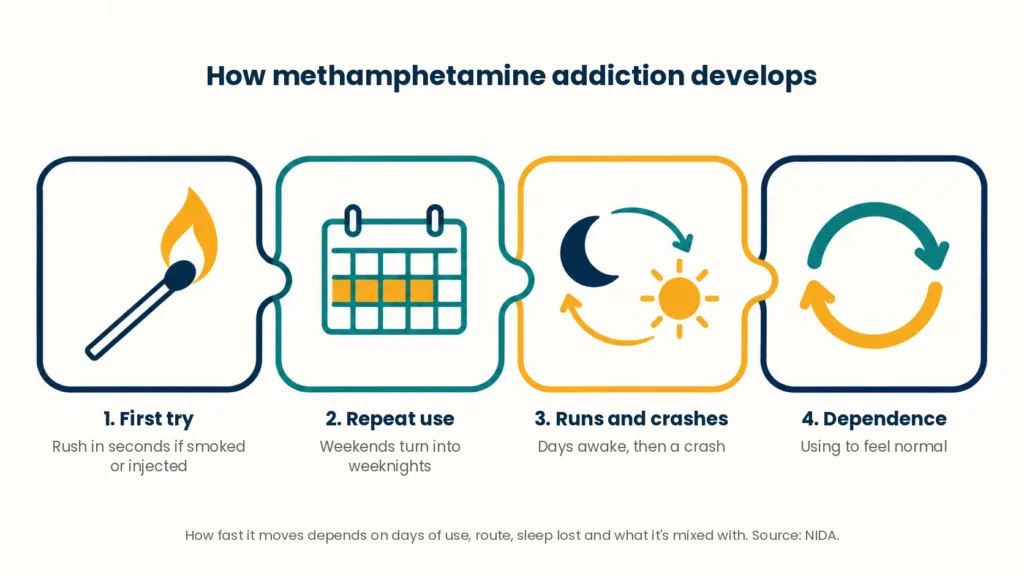
These stages describe a common pattern, not a fixed path. Some people never move past the first 2, and the pace varies from person to person.
How long does it take to get addicted to meth?
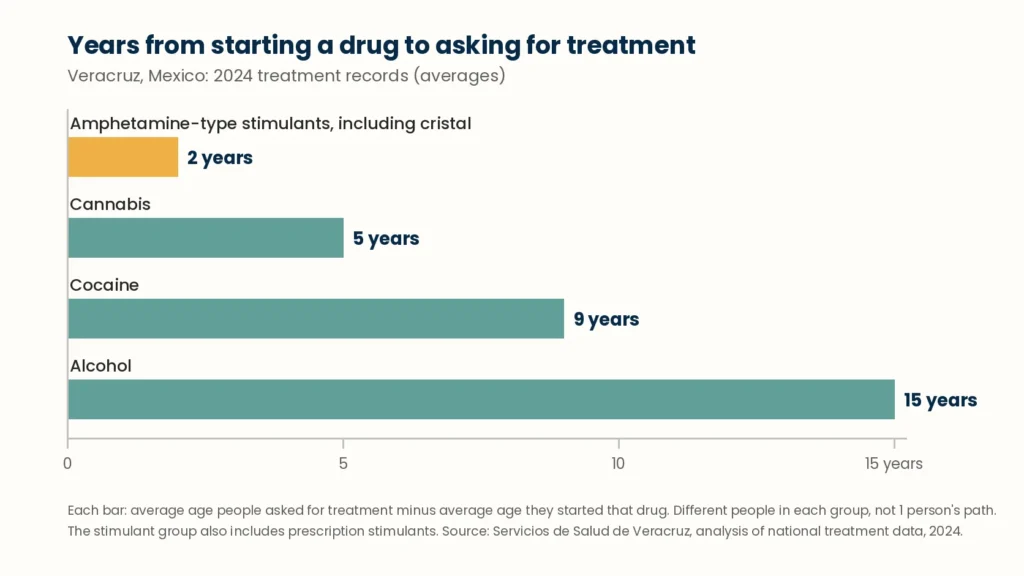
There’s no set number of days or doses, because frequency matters more than time. Still, treatment records from Veracruz show meth problems reach treatment fast. In 2024, people there asked for help 2 years after starting meth-type stimulants, compared with 9 years for cocaine and 15 for alcohol.
| Drug people sought help for | Average age they started it | Average age they asked for treatment | Gap |
| Amphetamine-type stimulants, including cristal | 23 | 25 | 2 years |
| Cannabis | 16 | 21 | 5 years |
| Cocaine | 22 | 31 | 9 years |
| Alcohol | 16 | 31 | 15 years |
Source: Veracruz state analysis of national treatment data, 2024. These are averages for different groups of people, not 1 person’s path, and the stimulant group also includes prescription stimulants such as Ritalin. The gap measures time to treatment, not time to addiction.
Across all drugs, the national gap is longer. National treatment data from CONASAMA, Mexico’s federal commission on mental health and addictions, show that people who entered treatment in 2022 had tried their first substance at 15, started their main drug at 19 and asked for help at 29, a 10-year wait. People are also starting meth-type stimulants later: the average age of first use rose from 18.9 in 2016 to 22.1 in 2025.
Addiction can build in months. Getting out usually takes longer, as our guide to meth recovery rates shows.
Why the “1 hit” warning gets it wrong
We push back on 2 common claims. The first is that a single hit of meth hooks you. In Mexico’s 2025 survey, about 4 in 5 people who had ever tried amphetamine-type stimulants hadn’t used them in the past year. A survey can’t show who struggled before stopping, and that group includes MDMA, but it shows that trying these drugs and staying on them are different things.
The second is that meth addiction builds slowly over years. Once use is regular, it often doesn’t. In US survey data from 2017 to 2019, 60% to 67% of adults who used meth in the past year had a use disorder or injected the drug. Those figures come from people already using in the past year, not everyone who ever tried meth. The risk follows frequency, which is why we treat weekly use as the point to act.
Why Is Meth So Addictive?
It hits the brain’s reward system harder and for longer than most drugs. Then it changes that system.
Meth does 2 things to dopamine, the brain chemical behind reward and motivation. It makes nerve cells release more of it, and it stops them from taking it back. Cocaine only does the second, which is why meth drove dopamine much higher in animal studies. Meth also lingers: half a dose is still in the body after 12 hours, against 1 hour for cocaine.
Over time, the brain adapts. NIDA reports that brain scans of long-term users show changes in the dopamine system linked to slower movement and weaker verbal learning, plus changes in areas tied to emotion and memory. Some of it heals. In 1 imaging study, some brain regions recovered after 14 months without meth, but not after 6, and other regions still hadn’t recovered at 14 months.
The 4 Things That Set the Speed
How often someone uses it, how they take it, how much sleep they lose and what they mix it with. Our screening asks about all 4 before it asks how much. [CONFIRM: these questions match the current intake form.]
| Factor | What the research shows | What we ask |
| Days of use per month | Psychosis risk rose with more days of use per month (McKetin and colleagues, 2013) | How many days in the last 30? |
| How it’s taken | Smoking and injecting bring an instant rush, which NIDA links to higher addiction risk | Smoked, snorted, swallowed or injected? Has that changed? |
| Sleep lost | Runs mean days of use in a row without food or sleep (NIDA) | What’s the longest stretch awake in the last month? |
| What it’s mixed with | Using cannabis or alcohol on 16 or more days a month about doubled the odds of psychotic symptoms (McKetin and colleagues, 2013) | What else, including pills bought as something else? |
These factors shift risk across groups of people. None of them predicts what will happen to 1 person.

Every stimulant case gets its EKG read by our cardiologist against a stricter cutoff than we use for opioids.A stricter screen lowers risk; it doesn’t make ibogaine safe.
Meth Psychosis Tracks Days of Use
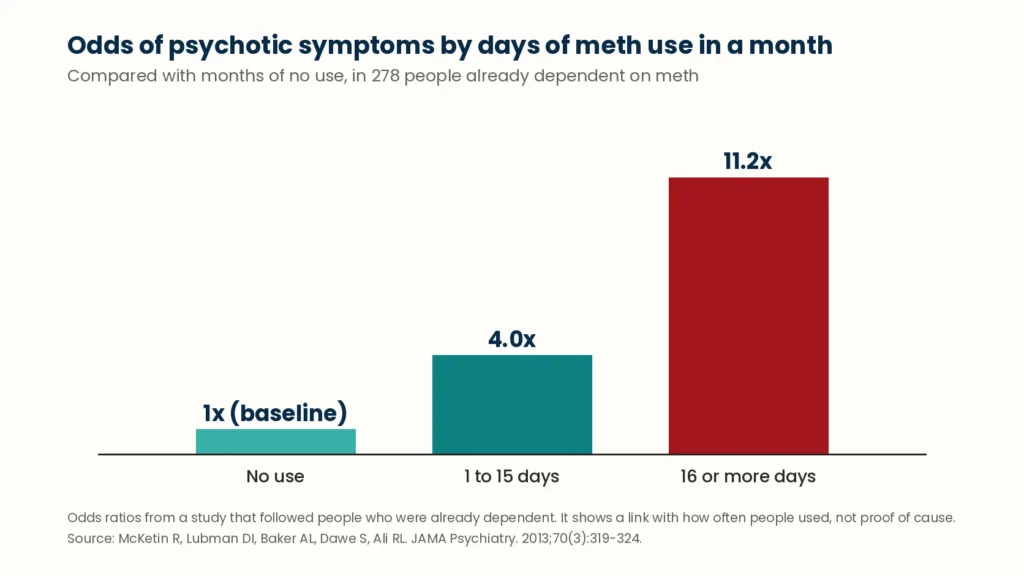
Psychosis from meth depends more on how often someone uses it than on how long they’ve used it. Heavy months bring it on, and months without meth usually ease it.
In an Australian study of 278 people dependent on meth, psychotic symptoms were 5 times as likely in months when they used than in months when they didn’t. The more days, the higher the risk: 4 times as likely at 1 to 15 days a month and 11 times as likely at 16 or more. The researchers found that symptoms mostly stayed within periods of use. The study followed people who were already dependent, and it shows a link with frequency, not proof that frequency alone causes psychosis. NIDA adds that in some people symptoms last months or years after quitting, and stress can bring them back.
What families notice is paranoia, such as the belief that someone is watching or following them. Hearing voices, or picking at skin to get rid of insects that aren’t there, can come with it.
If someone is in danger, call 911. For guidance at any hour, Mexico’s Línea de la Vida is free and confidential at 800 911 2000.
Who’s Most at Risk In Mexico in 2026
Young adult men, people who already use other drugs, and people in states where stimulants lead treatment demand.
In Mexico’s 2025 survey, 20.1% of men aged 12 to 65 had ever used an illegal drug, against 6.7% of women. The share of adults who had ever used amphetamine-type stimulants rose from 0.9% in 2016 to 1.6% in 2025, while the share of teens dipped from 0.6% to 0.5%.
Treatment data point the same way. Of the 167,905 people who asked for addiction treatment in 2022, 83.7% were men. Stimulants were the main drug for 49% of the men who sought help, while alcohol led among women at 35%. Stimulants were the top treatment drug in 21 of Mexico’s 32 federal entities. These figures count people who asked for treatment, not everyone who uses, and the stimulant group also includes ecstasy and prescription stimulants.
US national data add more risk markers. Meth use, use disorder and injecting were all more common among people with lower incomes, unstable housing, depression or other drug use. Those patterns come from the US and may differ in Mexico.
Meth in Mexico: Where It Comes From and What the Law Says
Most meth sold in North America is now made in Mexico, and Mexican law lists it as a controlled psychotropic.
UNODC’s 2026 World Drug Report describes a 20-year shift in meth production from the US to Mexico. DEA says cartels make it in Mexican labs with precursor chemicals from China, and NIDA noted back in 2013 that Mexican labs were moving to a method called P2P, which doesn’t need cold medicine. The result is strong and uniform: US seizures have held near 95% purity since 2021, according to UNODC.
It also turns up where people don’t expect it. UNODC reports a sharp rise in the US in fake Adderall pills and fake MDMA tablets that contain meth, and in US lab data, 1 in 8 meth samples also contained fentanyl. Those are US figures; Mexican street samples may differ. If fentanyl shows up on our drug screen, we plan the case around fentanyl dependence first. [CONFIRM: this protocol.]
Under Mexico’s General Health Law, meth sits on list II of Article 245: psychotropic substances with some therapeutic value that are also a serious public health problem. Article 479 sets 40 mg as the most that counts as personal, immediate use. This is general information, not legal advice.
What Are The Signs of Meth Addiction?
Sleep often changes first: nights awake, then whole days asleep. Weight loss, money problems, secrecy and new suspicion of others tend to follow.
Other signs include fast talk, jaw clenching, skin sores, dental damage, mood swings and missed work or school. A single sign doesn’t prove meth use. A pattern that gets worse month by month is the thing to act on.
In Mexico, help can start with a free call to Línea de la Vida at 800 911 2000, which refers callers to specialized care. Public options include CECOSAMA community centers and Centros de Integración Juvenil. NIDA names behavioral therapies, such as contingency management, which rewards drug-free urine tests, as the most effective treatments for meth addiction. Our guide to treatments that work ranks the options by trial evidence.
Families also ask us about ibogaine for meth. Ibogaine isn’t a proven treatment for meth addiction, and it isn’t a cure for any addiction. We haven’t found a published study that gave ibogaine to a group of people dependent on meth, so nobody can say whether it helps. It also carries real risk: ibogaine affects heart rhythm, a 2012 review counted 19 deaths after people took it between 1990 and 2008, and years of meth may already have strained the heart. Our meth screening rules explain who we turn away and why.
If you’re reading this because someone you love may be using meth, start by counting days, not grams, and watch their sleep. If you want to know whether ibogaine is even an option for them, you can start a screening with their medical records. A physician reviews them before any money changes hands, and the answer can be no.
This article is information, not medical advice.
Questions families ask about meth addiction
Is meth addiction a disease?
Doctors treat it as one. NIDA calls addiction a chronic disease that tends to come back. People keep using despite harm, and the brain changes in ways that last. The medical name for meth addiction is stimulant use disorder, rated mild, moderate or severe using 11 criteria.
What is methamphetamine addiction called in Mexico?
Mexican researchers call it trastorno por uso de metanfetamina, or methamphetamine use disorder. Most people call the drug itself cristal. Mexico’s national drug survey counts cristal as an amphetamine-type stimulant, in the same group as MDMA.
Can you get addicted to meth after 1 use?
A single use rarely leads to addiction, but it isn’t safe. In Mexico’s 2025 survey, 1.5% of people aged 12 to 65 had ever used amphetamine-type stimulants, but only 0.3% had used them in the past year. Risk climbs fast once use turns regular: in US data, 60% to 67% of adults who used meth in the past year had a use disorder or injected it.
How long does it take to get addicted to meth?
There’s no fixed timeline, because how often someone uses matters more than how long. In Veracruz’s 2024 treatment records, a state-level snapshot, people seeking help for meth-type stimulants had started using them at 23 on average and asked for treatment at 25. For cocaine, the gap was 9 years.
Does meth psychosis go away?
Usually, yes. In 1 study of 278 people who were already dependent, symptoms clustered in months of use and were 11 times as likely in months with 16 or more days of use. NIDA notes they can last months or years in some people, and stress can bring them back.
What does Mexican law say about meth?
Meth is a controlled drug under Mexico’s General Health Law. Article 245 lists it as having some medical value but posing a serious public health problem. Article 479 sets 40 mg as the most that counts as personal, immediate use. That limit shapes how the law treats possession; it doesn’t make meth legal.
Sources
- Alper KR, Stajić M, Gill JR. Fatalities temporally associated with the ingestion of ibogaine. Journal of Forensic Sciences. 2012;57(2):398-412.
- American Psychiatric Association. Diagnostic and Statistical Manual of Mental Disorders, Fifth Edition (DSM-5). 2013.
- Comisión Nacional de Salud Mental y Adicciones (CONASAMA). Hoja de datos: contexto de la demanda de sustancias ilícitas en 2022-2023. June 26, 2023.
- CONASAMA. Línea de la Vida, 800 911 2000.
- Han B, Compton WM, Jones CM, Einstein EB, Volkow ND. Methamphetamine use, methamphetamine use disorder, and associated overdose deaths among US adults. JAMA Psychiatry. 2021;78(12):1329-1342.
- Instituto Nacional de Salud Pública, CONASAMA and Instituto Nacional de Psiquiatría Ramón de la Fuente Muñiz. Encuesta Nacional de Consumo de Drogas, Alcohol y Tabaco (ENCODAT) 2025: full report and executive summary. December 2025.
- Ley General de Salud (Mexico), Articles 245 and 479.
- McKetin R, Lubman DI, Baker AL, Dawe S, Ali RL. Dose-related psychotic symptoms in chronic methamphetamine users: evidence from a prospective longitudinal study. JAMA Psychiatry. 2013;70(3):319-324.
- National Institute on Drug Abuse. Methamphetamine. Research Report Series, NIH Publication No. 13-4210. Revised September 2013.
- Relación entre el craving y el trastorno por uso de metanfetamina en pacientes en tratamiento residencial del Estado de Aguascalientes, México. Cultura y Droga. 2025;30(39). doi:10.17151/culdr.2025.30.39.3.
- Servicios de Salud de Veracruz, Centro Estatal contra las Adicciones. Demanda de tratamiento por consumo de sustancias psicoactivas 2024, with data from the Observatorio Mexicano de Salud Mental y Adicciones. June 2025.
- United Nations Office on Drugs and Crime. World Drug Report 2026: methamphetamine supply in North America. 2026.
- US Drug Enforcement Administration. 2025 National Drug Threat Assessment. May 2025.
This article is information, not medical advice. Ibogaine is not approved by the FDA and carries cardiac risk. Whether it is an option for you is decided by a physician after an EKG and blood tests, never by an article. If you or someone else is in danger now, call your local emergency number.